Latest Observations and Reflections
On
this page you will find a chronological listing of seal
observation notes for the current seal watching season, as well as occasional short
essays inspired by the people and creatures encountered on our nature
walks and outdoor adventures. We hope you enjoy these notes
and
essays. If you have any seal observations to pass
along or just want to say hello, please contact us at romepointseals.org
12-21-2017 56 seals hauled out, 36 degrees, NNW 5 to 10, clear, 15:00
2 seals on far rock for 58 seals total. At last, we got to enjoy a most pleasant seal hike this afternoon, as the seals were undisturbed for the first time this season. It was all good today with well-posed seals in good light, a smattering of active behavior, including porpoising and vocalization, and a sighting of Rome Point stalwart seal Linebelly to add an exclamation point to the end of our seal observation. This afternoon was made all the more pleasant by the contrast to our recent unsuccessful seal walks, indeed, absence does make the heart grow fonder.
We also enjoyed spending time with Katy and her companion from Vermont, who showed considerable interest in the seals as well as noteworthy observational skill. It turns out that Katy learned her water watchful ways in search of Champ, the legendary Water Horse of Lake Champlain. She has had several sightings and soundings (using hydrophones, which she had with her) of the elusive lake monster, and has posted some video and audio evidence on the website Champ Search as well as a number of interesting first-hand accounts of Champ sightings. We fondly hope that some day our new friend Katy is rewarded for her years of effort by obtaining indisputable video evidence of the existence of Champ; she has certainly come close, and is as personable and sincere of a human ambassador for Champ as the famous creature could have. We have held an interest in fabled creatures such as the Yeti, Saskwatch, Nessie, and Champ (as well as the proven living fossil the coelacanth) since childhood, and would be very gratified to have the existence of one of these animals proven beyond all doubt.
First Seal Observation for Winter 2017/2018
12-16-2017 26 seals hauled out, 24 degrees, WNW 15 to 20, clear, fresh snow 10:30
Seal watching peaked too soon today, as the sound of the shotguns of late autumn duck hunters were too much for the seals to tolerate. There were seals in sight the entire time we were there, but most of the seals flushed after a big shotgun volley shortly after our arrival, and only a few returned to rest on the rocks. We have not even bothered to record our first four seal observations this fall on the website, because on all prior recent visits, the seals were not on the rocks due to the presence of watercraft in the area. This marks our 18th year of seal watching at Rome Point and it has certainly been the most disappointing start of the season we have ever experienced, as the moderate weather in November and December allowed for an extended boating season. Still, we know thateventually winter will serve to keep most boats and kayaks off the water, to the benefit of the resting seals and eager seal seekers alike.
Last Seal Observation for Spring 2017
4-15-2017 22 seals hauled out, 58 degrees, SSW 15 to 30+ clear, 16:00
High winds this afternoon were responsible for the low seal count, even though a southwest wind is usually a favorable wind direction. Once the wind velocity gets up around 30 knots, its too windy for good seal watching, but we enjoyed a pleasant visit on the beach with a good number of other seal observers. When we first arrived we were entertained by watching the seals on the center cluster trying to get settled in the face of periodic larger waves that would wash over the rock... and wash the seals back into the water. These seals would then gamely haul out again, only to be lambasted again by another set of large waves a few minutes later. Finally, the tide receded sufficiently such that the cluster rock was above the wind-driven wave fray, allowing the seals to rest undisturbed as a reward for their persistence.
4-9-2017 115 seals hauled out, 55 degrees, W 5 to 15 clear, 11:00
6 seals on far rock for 121 seals total. Outstanding seal watching early in the tide until a couple of kayaks showed up at 11:05, with plenty of extremely vocal and aggressive seal behavior on display. The kayakers seemed oblivious to the seals and did not approach the rocks, but they flushed most of the hauled out seals into the water. A lot of seals returned to the haul out rocks and remained well posed for the many seal seekers who came out to Rome Point today to admire.
4-8-2017 176 seals hauled out, 52 degrees, NW 10 to 15 partly cloudy, 12:30
7 seals on far rock for 183 seals total. A great Spring seal watch with a large number of hauled-out seals resting placidly on the rocks and excellent lighting for close-up viewing through the scope. It was a somewhat distracted seal watch for us, as we entertained a good number of visitors and a canine companion while trying to keep tabs on the seals. We arrived too late to see the seals in action as they hauled out, and the herd was mostly asleep by the time we got there at low tide. We did get to see examples of most typical seal behaviors, and as the tide came in, there were several ferocious seal fights as the seals crowded into each other's personal spaces in an effort to stay high and dry. The best match was between a seal my granddaughter named Specklebelly and an intruder who encroached on Speck's favorite rock. These two seals snapped fiercely at each other, delivering bites to the neck and chest until they took their quarrel into the water to settle matters. We were amused to see Specklebelly clambering back up onto the rock after about ten minutes, suggesting the it took these two combatants a while to settle their quarrel before Specklebelly emerged victorious. Big red on cluster. Lucy, Audubon group, and horses.
4-2-2017 45 seals hauled out, 40 degrees, NW 15 before we arrived, then S 10 to 15, to NW 5 to 15 partly cloudy, 17:00
A very unusual seal watch, with some unexpected weird weather that affected the seals and the seal observation. When we left home the wind was out of the NW at a steady 15, but by the time we arrived at the Rome Point shore, the wind had strangely shifted to the south. Not surprisingly, the seals were not impressed with this development occurring right at their haul-out time, and there were few seals hauled out as the west wind served to hold the neap tide up in the bay. There were a good number of people around, so we hung around as well and were astonished when the wind pulled another 180 degree wind shift back to the NW. We are almost up to 800 seal observations, but we have no prior records of a strong wind switching so quickly in two directions. After the wind shifted back to the NW, the two southern-most rocks filled up with big seals, so there were some seals well positioned for viewing late in the afternoon, but for us, this day was memorable mostly for the wacky weather and the way the seals behaved as the wind it changed and shifted.
3-30-2017 148 seals hauled out, 40 degrees, NE 5 to 15, clear, 14:30
6 Seals or far rock and 3 at Greene Point for 157 seals total. Outstanding seal watching today, with numerous active seals in the area and excellent light for telescopic observation. The easterly wind was similar to our last seal watch in that it was cool, but not sufficiently harsh so as to make our time in the beach uncomfortable. There were about 70 seals on the rocks when we arrived, and we watched as the seal count doubled and numerous seals displayed active behavior, either territorial procurement or just being happy jumping frolicking seals. One seal jumped repeatedly 8 consecutive times, and a half-dozen other seals performed lesser, but still impressive, aerial displays. The taller rocks were covered with large seals, and some of these animals moved to lower haul out locations as the astronomical low tide receded. This resulted in a continuous re-shuffling of the seals' locations, with the associated vocalization and confrontational behavior providing for an truly action-packed seal watch. Almost all of the lower rocks were battlefields at one time or another, and the aggressive behavior seemed particularly violent and prolonged today, with one skirmish on the right mound actually drawing blood from a ferocious bite on the neck.
We spotted Big Red the resident Grey seal on the tall rock again today, and when the big fella made his move to the already jam packed cluster, this caused a veritable seal riot on the cluster. Some big harbor seals on the front of the cluster were able to fend off Big Red at first, and the Bid Red signaled his displeasure with the haunting siren song of the Grey seal. The larger Grey seal was not to be denied, and continued probing different locations on the back of the cluster until he was finally able to locate a less ably defended access point. As Big Red muscled his way into position, about 10 harbor seals were forced to move over, which caused them to fight among themselves for a good 15 minutes until all the remaining seals were re-settled comfortably.
Additional comments on this seal watch to be posted later.
3-25-2017 98 seals hauled out, 45 degrees, NE 5 to 15, cloudy, 11:00
6 Seals on far rock for 104 seals total. Very good seal watching today for the first time in a long time, as the easterly wind, while chilly, was not strong enough to be too uncomfortable for the seals or the seal watchers. The numerous seals present were well posed for telescopic viewing with excellent light for the scope, so the many families who joined us on the Rome Point shore today enjoyed clear views of fairly active seals. The best morning activity took place when Big Red the Grey seal made a move from the top of one of the tall rocks to the center cluster of harbor seals. The smaller harbor seals were powerless to prevent the Grey seal from resting anywhere it wished, but the disruption cause by Big Red moving in led to a major skirmish among the displaced harbor seals as they fought among themselves to establish comfortable new resting territories.
A pair of kayakers passing through the area at 11:05 flushed about 2/3 of the seal herd; however, the paddlers did not approach the rocks and many of the seals returned and took up new resting stations, which resulted in about 45 minutes of interesting active seal behavior. An hour after the kayaks passed by there were about 70 seals hauled out for our long-time seal watching friends Rhode Families in Nature to enjoy. This large contingent of families with mostly young children in tow make a Rome Point hike an annual event, and we were very pleased that the kayakers left the seals mostly undisturbed so Jeanine's group all had ample opportunities to see wild seals up close and personal through our spotting scopes. As the smiling kids and adults took their turns at the scopes, I could not help but contrast all the fun everyone was having to how the different and disappointing the situation would have been had less knowledgeable, discourteous kayakers been in the vicinity today. If the kayakers had paddled out to the rocks and approached the seals, they would have spoiled the seal show for everyone, but instead, because they knew what they were doing, the self-aware, skilled kayakers we observed got to enjoy their chosen pastime without ruining today's seal watch for all of the friendly families who enjoyed a great seal hike today.
3-12-2017 0 seals hauled out, 42 degrees, WNW 15 to 20, clear, 11:00
The most disappointing seal hike of the season so far, with no seals on the rocks and only a couple of swimmers spotted in the half-hour we spent at Rome Point. Conditions were perfect for a big seal turn out as far as we could tell, but there were just no seals around for reasons that remain a mystery to us. Perhaps the seals were run off the rocks by watercraft before we arrived, but we were there two full hours before low tide and usually, at least a few seals will haul out while the tide is still running out, even if most of the herd has been spooked hard by boats or kayaks that approach the rocks and remain in the area. The swimming seals that approached the rocks behaved in a manner similar to how they act when the wind is unfavorable or a front is passing through the area, but on this day the weather conditions were almost ideal. Today was one of the most puzzling (no) seal observations we have had in over 15 years at Rome Point, so we suspect human activity may have disturbed the seals before our arrival this morning.
3-9-2017 75? seals hauled out, 52 degrees, W 20 to 30+, clear, 10:15
Our seal watch today was unusual in that it was blowing a gale on the bay and we were accompanied by a polite group of environmental studies students from Blackstone Academy charter school. Because of the large group that was present, we did not do our usual detailed seal count, but it was clear that the big wind reduced the number of seals on the rocks and made the seals that were there somewhat unsettled. The seal watchers were as interesting to observe as the seals today and with a big group of teenagers it was fascinating to watch how the different groups of kids showed different levels of interest and a variety of behaviors much more variable than the seals. Some of the kids that "got it" and focused on the wildlife observation had good opportunities to see some interesting seals and marine mammal behavior, while for others the outing was little more than a pleasant hike on the beach. I found a large, partly broken channeled whelk shell, with the animal still inside, to show the group and the omnipresent Asian shore crabs never fail to entertain, but for the most part the level of interest was somewhat lacking. However, this was all the better for the kids like Liz, Hugo, Shawn, and a few others whose names I did not catch, as those who wanted to were able to enjoy a fairly good seal watch considering the windy conditions.
I was fairly distracted most of the time, but I did manage to spot my old seal friend "Big Red" the Grey seal for the first time this year among the harbor seals on the cluster. Other seals such as Linebelly and the seal with the fresh net entanglement were also on the rocks, but viewing conditions were only fair at best, and the prime rocks to the south were unoccupied due to excessive splashy wave action. At about 10:30, a good number of the seals left the rocks, and we departed shortly thereafter. On the way back to the parking lot, I pointed out the croaking calls of the woods frogs, a harbinger of Spring which I was hearing for the first time in 2017. I remarked that they better get their croaking in today, as with late-winter snow in the forecast, it may be a while before the calls of amorous amphibians are heard again at Rome Point.
2-26-2017 86 seals hauled out, 44 degrees, SW5 to S 10+, clear, 13:00
We enjoyed fairly good seal observation today, with a good number of people around to share in the Sunday seal watching fun. Our notes from this seal watch are sketchy, but many of the same seals we have been seeing the past five days were perched on their customary rocks, with the taller rocks being unoccupied. The light for the scope was considerably better that it has been lately, which allowed for more clearly focused close-up views of the seals, and we stayed much longer than we intended, having to drive to Bangor, Maine when our seal watch was concluded today.
2-24-2017 107 seals hauled out, 58 degrees, SW5 to S 10+, clear, 10:45
6 seals on far rock for 113 seals total. Today's seal watch was a carbon-copy of yesterday, which is to say there were lots of interesting seals, and crummy lighting conditions for telescopic observation. Even the seal's sudden departure at 1:25 was identical to their behavior yesterday. When the south wind picks up to around 15 knots on the flood tide, the seals will often depart all at the same time rather hastily, and this happened again today. All of a sudden, about 80 seals took to the water with almost no advance indication they were going to leave, and all of these seals immediately vacated the premises with nary a glance back at the rocks as the herd headed towards the ocean.
2-23-2017 102 seals hauled out, 54 degrees, SW5 to S 10+, clear, 10:00
6 seals on far rock for 108 seals total. Very good seal watching this morning, that was only prevented from being outstanding by the poor light conditions for telescopic observation. When the spring sun is bright and humidity is high, optical distortion is magnified along with the seals' image, which degrades the clarity of the image and limits the amount of magnification we can dial up on our spotting scope. This is of little concern to casual observers, but we have become rather particular for our own seal observation purposes, and much prefer the crystal clear views we get of the seals on cloudy or less humid days.
That said, the numerous seal seeking families that we met today were perfectly happy to see nearly 100 seals on the rocks through the scope. The warm conditions on the sheltered shoreline allowed people to linger on the beach comfortably, and several groups took several turns at the scope. The seals were especially well-settled and most slept soundly for a long time with very little activity. However, as the tide came in the seals started to move a bit, and we watched with interest as a couple of seals got into a bit of a dust up over a particular haul-out rock. Upon closer examination we were very pleased to see that one of the seals was the seal that my granddaughter named Specklebelly last spring, and that Specklebelly, with his distinctive spot pattern, was back on the very same rock where I photographed him in 2016.
By 1:00 pm the wind was pushing the rising tide well up onto the rocks and the seals departed hastily. This was unfortunate for the many hopeful afternoon seal watchers who had filled the parking lot to overflowing on this spring-like day. The RI DEM sponsored a hike today starting at 1:00 pm, and upon learning about this walk last week we contacted the DEM parks department and suggested that 1:00 was a little late in the flood tide to expect to see many seals on the rocks. Unsurprisingly, we were not afforded the courtesy of a response and sure enough, anyone accompanying the DEM on their hike was no doubt disappointed that there were no seals to be seen. We have had repeated dealings with RI DEM on both a professional and recreational basis over the past 20 years, and in all cases, save a few interactions with research teams, we have found representatives of this agency to be sorely lacking in both competence and productivity. Rhode Island has many natural wonders and faces environmental challenges on numerous fronts, and we are continuously dismayed to see that the state agency primarily responsible for protecting the ocean state's natural resources is poorly managed, under-funded, and can barely muster even a lame effort in a number circumstances that we have personally observed or have firsthand knowledge about.
2-22-2017 60+ seals hauled out, 50 degrees, W5 to calm to S 10, hazy to clear, 10:00
We did not get a good seal count today because the seals were flushed from the rocks by kayakers before we arrived on the beach. We watched in dismay from afar as all of the seals, except for a single brave stalwart, were run off the rocks by kayakers on what would have otherwise been a perfect day for seal observation. However, the weather was so nice that about 8 seals returned to the rocks after the kayaks departed, and additional seals gradually came back over the next 1 1/2 hours. When Linebelly returned to the pointy rock and another seal hauled out on the slanted rock, we had a couple of seals at least that were well posed for viewing; later, seals on the right mound and flat rock provided additional good looks at a few seals. We even got to observe one brief flurry of activity in the water as one small seal porpoised 3 times in quick succession. All in all, this seal watch turned out much better than we would have supposed, which saved the day for a few seal seekers who joined us on the beach before the building south wind dispersed the seals just before 1:00pm.
2-21-2017 63 seals hauled out, 43 degrees, N5 to calm to S 15, clear, 10:15
5 seals on far rock for 68 seals total. A very pleasant morning seal watch, but a bit solitary for our taste, considering it's winter school vacation week. Still, the seals obliged us with excellent views all morning and one new friend chose an excellent morning to enjoy a lengthy, and hopefully informative, seal watch with us. At 11:10, all but about 10 seals spooked for no apparent reason, which was somewhat unusual as the large mature seals were the first to show signs of anxiety and take to the water. Usually the stalwart seals on the far right flat rock are the last to be fooled onto thinking that a non-existent threat is approaching, but today, they led the herd off the rocks and into the safety of the water. The seals spy hopped about looking in all directions, and when no intruders were spotted about 35 seals returned to the rocks, which is always interesting to observe.
We had to leave around 11:30, but we rounded up one family to show them the seals before we left, and the children were pleased to get close-up looks at the seals. One seal that has a net entanglement around its neck hauled out in profile on the slanted rock, which I showed the kids while explaining how this seal got its necklace. The last little girl to look enjoyed an exceptional observation as she exclaimed, "he's pushing him". Sure enough, the seal that was previously on the slanted rock before the herd flushed had returned, intent upon reclaiming his desired perch. The seal with the net necklace put up a game defense of his position, which made for exciting action until the larger seal finally dispatched him off the rock with a big splash, and clambered up to take his rest. The little girl was most amused by this sight, and was grinning broadly as she left the scope to play with the other children, in the manner of the cat that got the seal watching canary as a reward for her patience in taking her turn at the scope.
2-17-2017 47 seals hauled out, 38 degrees, WNW 10, clear, 15:45
We had a little time in the late afternoon for a quick seal scouting mission and trail condition check, both of which were successful. As we expected the seals were out enjoying the late day sunshine, and, also as expected, some sections of the trail were icy and very slippery. We just did a quick seal survey through binoculars, which revealed the striking, copper-colored seal we observed a couple of weeks ago hauling out on Linebelly's favorite pointy rock, while Linebelly was laying on the adjacent flat rock that he has lately shown some affinity for.
2-11-2017 10 seals hauled out, 38 degrees, N 5 to N 15, cloudy, 13:30
5 seals on far rock for 15 seals total. The seal count was surprisingly low today, for reasons that took a while to become apparent to us. At first we thought the seals had been spooked before we arrived by watercraft in the area, but as the wind picked up we noticed it was directly out of the north, not the predicted west wind that the seals greatly prefer. When we checked our Windfinder app, we saw that the wind had suddenly shifted from south to north about an hour and a half before we arrived, signaling the passage of a cold front through the area. When a frontal passage coincides with the seals' haul-out time, the seals are able to sense this and it affects their behavior; in this case, many seals chose to remain in the water today.
2-8-2017 81 seals hauled out, 58 degrees, SW 5 to 10 to NW 15, hazy, 14:30
1 seal at Greene Point and 5 on far rock for 87 seals total. We could not resist the temptation to enjoy this spring-like day on the Rome Point shore, especially in light of tomorrow's forecast for a foot of snow. We were rewarded with the most seals we have seen this winter, however, the hazy, humid conditions were less than optimum for telescopic observation. Still, the seal watching was well worth the time invested, with somewhat active, and quite talkative seals on every rock for us to see. Linebelly was back on his long-time favorite pointy rock, and he, as well as many other seals, extended their rest cycle as long as they could into the incoming tide. The seals had to contend with a blustery day yesterday which was likely not conducive to good rest, and with blizzard conditions on tap for tomorrow, its was almost as though the seals had looked at the same weather forecast as I had, and were resting up today to ride out the coming snow storm.
1-29-2017 64 seals hauled out, 40 degrees, W 15+ to 10, partly cloudy, 14:30
1 seal at Greene Point and 2 on far rock for 67 seals total. The seal were much earlier to arrive than they were yesterday and most of the rocks were well populated when we arrived at noon. A fair number of seals took up stations on the same rocks that they occupied yesterday, including Linebelly and the seal with the double neck entanglement scar that will from now on be referred to as Ringneck. As is occasionally the case, on this day several groups of visitors declined our offer to get a good look at the seals through the scope at first; the amateur sociologist in us always wonders what it is about certain days or circumstances that causes people to be a bit standoffish in this most non-threatening social situation. Once one family takes a look through the scope and begins to relate to me and to each other talking about the amazing up-close views of wild harbor seals, and others see this interaction, then everyone else wants to look at the seals too. However, when it is just myself standing there, as is the often the case when I first arrive, occasionally some people do decline my invitation to view the seals through the scope; this happened twice today right off the bat. I always try not to "hijack" anyone's experience on the beach and rarely invite people to use the scope until they are getting ready to leave, as I have been taught to do by my professional naturalist mentors, so it's not as though I am aggressive in any way. I am not put off by this in the least, I just find it interesting to note how people sometimes take their cues from the behavior of others even in the most casual, relaxed environment; while on most days, everyone is eager to see the seals, whether or not other seal watchers are present.
Once the seal watch got rolling, everyone enjoyed a fine Sunday afternoon watching the seals, including one very nice group of about six little girls whom we met seal watching last year. These kids showed no shyness or aloofness in using the scope and commenting on their observations, to the delight of everyone present. I could not help but wonder if the groups that declined my invitation to share the spotting scope earlier today would have responded differently if they had witnessed these happy, grateful kids at nature play. At 2:15 a fast-moving kayaker paddled through the area, flushing about 40 seals off the rocks, and leaving only those seals on the back clusters for us to observe. Several more families did get to see the seals, but the best of the seal watch was over and at 3:00 the kayaker returned and spooked the remaining seals, putting a premature end to what was nonetheless another in a string of recent good January seal observations.
1-28-2017 61 seals hauled out, 40 degrees, W 15+ to 10, cloudy, 14:00
1 seal st Greene Point for 62 seals total. The seal watch today got off to a slow start, as the seals were a bit tardy arriving considering the west wind/new moon circumstance, and we got to the beach just as the morning seal seekers were departing. We had the beach to ourselves as the pace of the seal arrivals quickened, and we enjoyed good observation as the seal hauled out. The highlight of the haul out was when our old buddy Linebelly showed up and found his new favorite flat rock already occupied. It took only seconds for Linebelly to decide that this challenge to his supremacy could not go unanswered, and and the big seal lunged from the water delivering a bite right to the face of his surprised opponent. Both seals took it outside to the water, where the battle was quickly decided in Linebelly's favor. As we watched this action unfold, we were not completely sure that Linebelly was actually the aggressor, but our initial suspicion was confirmed when he turned on his side and revealed his distinctive scar.
The rest of the seal watch was another fun and sociable weekend affair, with excellent light for close-up telescope observation and plenty of friendly company joining us on the beach. The low astronomical tide coupled with excellent viewing conditions kept us on the beach all afternoon, but late in the afternoon we were visited by a somewhat unusual guest. We heard an unusual high-pitched whine that we first attributed to distant dirt bikes, but when the sound persisted it became apparent that the odd noise was not motorcycles. When we finally looked up we spotted a quad-drone hovering directly above us high in the air. Our previous encounters with drones at Rome Point have resulted in the seals being flushed by the approaching drone, but today the drone's operator was satisfied to keep his distance, leaving the seals undisturbed. We have been contacted by a couple of drone hobbyists this season who have been considerate enough to inquire whether they might be able to check out the seals with their quad-copters, and we provided them with our recommendations. It pleases us to see that there are at least some... and hopefully many drone owners who are responsible stewards of their hobby and who realize that harassing wildlife with their aircraft might not be the best way to make friends or to cast their chosen avocation in a positive light.
1-22-2017 34 seals hauled out, 44 degrees, NE 5 to calm to N10 10, cloudy and hazy, 9:30
4 seals on far rock for 38 seals total. A hazy early morning seal watch under calm, neap tide conditions took an unexpected turn when a boat with a couple of waterfowl hunters on board made a sudden appearance at 9:45, spooking all of the seals from the rocks. The boat did not stay in the area, but we were not surprised that only a few seals returned to the rocks, as it was past low tide and the seals had already taken their rest. We were snapping the covers closed on the scope preparing for an early departure from the beach, when we spotted a little girl and her adult escort coming around the corner. We decided to hang around to show the seals to this intrepid duo, and as it turned out, this was a fortunate decision.
The bold little girl raced ahead of her more cautious grandmother across the rocky shore, and proceeded to plop down on a rock right beside us, in a manner that suggested this was not her first seal rodeo. When her Grammy arrived, I was introduced to young Ezri, who as it turned out, did indeed remember me from a previous trip to Rome Point, and we enjoyed her astute commentary as she surveyed the seals through the scope. She and her companion stayed around for awhile as they awaited the arrival of her father, and we continued to be entertained by Ezri's insightful questions, which gave us an opportunity to pontificate in some detail about seal and shark behavior to a steady stream of arriving seal enthusiasts. On a day when the seal show was rather run-of-the-mill for us, it was immensely pleasing for us to see how one special little girl was the catalyst for such a friendly, entertaining seal watch for everyone.
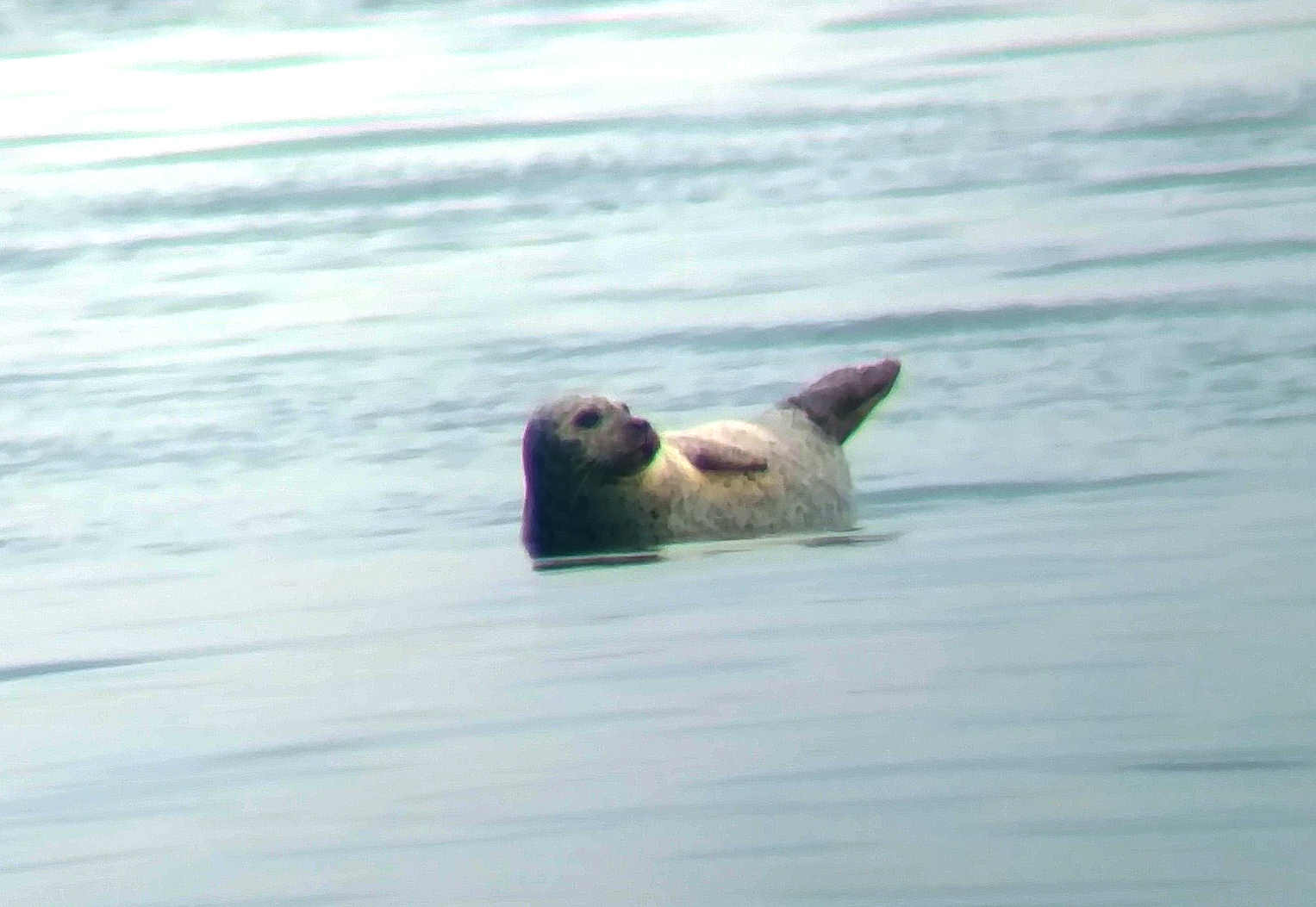
Conditions on the bay were calm for most of the morning, and as the stream of visitors slowed down during the usual lunch hour lull, we took the opportunity to get some photos illustrating examples of seal behavior on a calm day with a lazy tide. The seal pictured below gives the illusion of floating, but is actually resting on a submerged rock. With the slow current and no waves, this seal was able to maintain this position for an extended time as the tide came in...
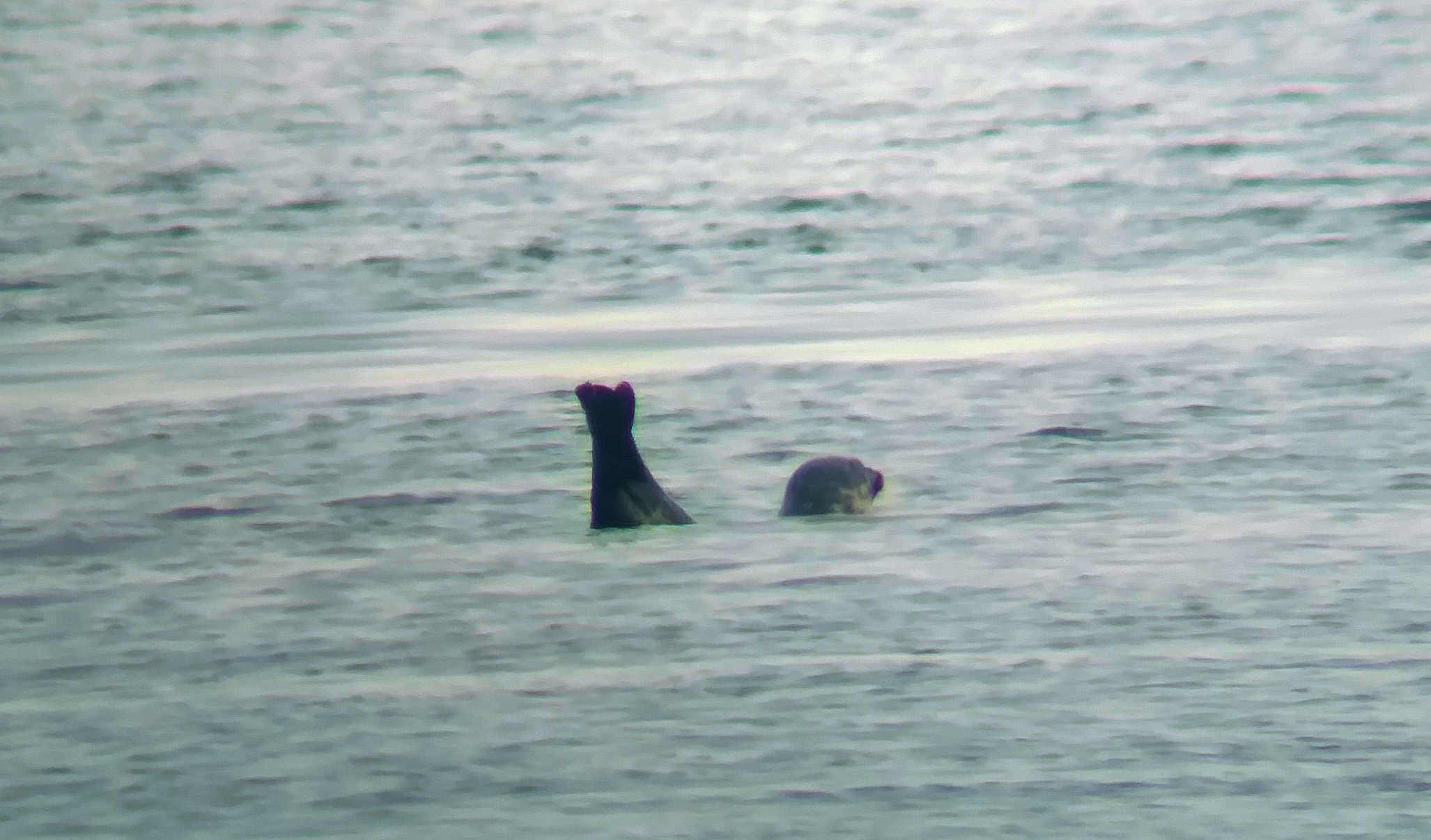
As did this seal as well, which struck the often-seen" banana" pose to a yoga-ish extreme and held this partially submerged position for a long time, as if it had attained the mindful relaxation of a yoga master.
1-16-2017 41 seals hauled out, 38 degrees, SW 15 to 10, clear, 14:00
Another fine January seal day, with a continuation of comfortable weather and a mellow, well lit seal show to keep the many families in attendance amazed and amused. One seal that has amused us often over the past 10 years is the inimitable Linebelly, who has shown less of an affinity for his customary pointy rock perch this season. Perhaps in his old age and ever increasing girth he has decided that a more comfortable resting rock is more suitable, as we have spotted him on this flat rock adjacent to the pointy rock on several occasions recently.
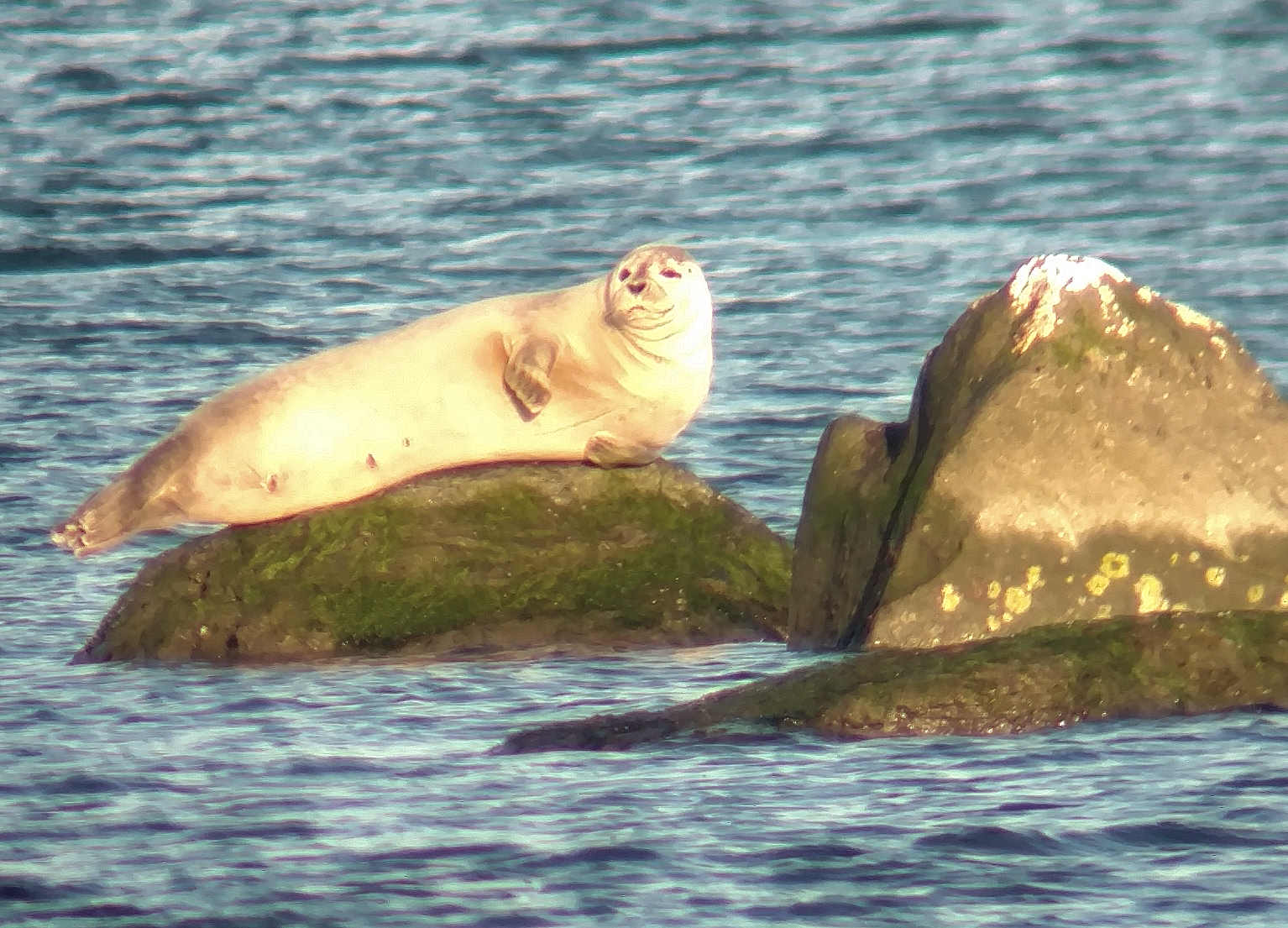
Another regular source of amusement at Rome Point are some of the dogs that accompany their owners on their hike. Today we were entertained by the presence of Roman, a king-sized 150 lb great dane. His calm and friendly disposition was most charming and he exhibited exceptional patience as his owner and her friends checked out the seals. I had just remarked on what a good seal watcher Roman was when a small dog appeared on the bank behind us, sending Roman into a brief but impressive frenzy of amazing vertical jumping, as his owner wrestled to restrain the leaping beast. The jumping height this dog could attain from a standing start was astonishing, and his owner told me she calls him kanga-Ro in recognition of his leaping prowess. Once again an afternoon at Rome Point showed us that you never know what you might see on a seal hike, and that the activity on the shore sometimes rivals the seals for entertainment value.
1-15-2017 43 seals hauled out, 36 degrees, NNW 15 to 10, clear, 14:00
5 seals on far rock for 48 seals total. A fine weekend seal watch today, with a good number of seals around and good-as-it-gets optical conditions for up close views of the seals through the scope. We arrived early enough to watch the seal herd populate the rocks, with a good amount of the behavior associated with seals hauling out on a nice winter day. For some reason known only to the seals, the usually favored flat rock remained unoccupied all afternoon, but other rocks were taken by seals well-posed for many first-time Rome Point visitors to admire. One seal that is getting a lot of attention is the seal shown below with the striking copper-colored coat.
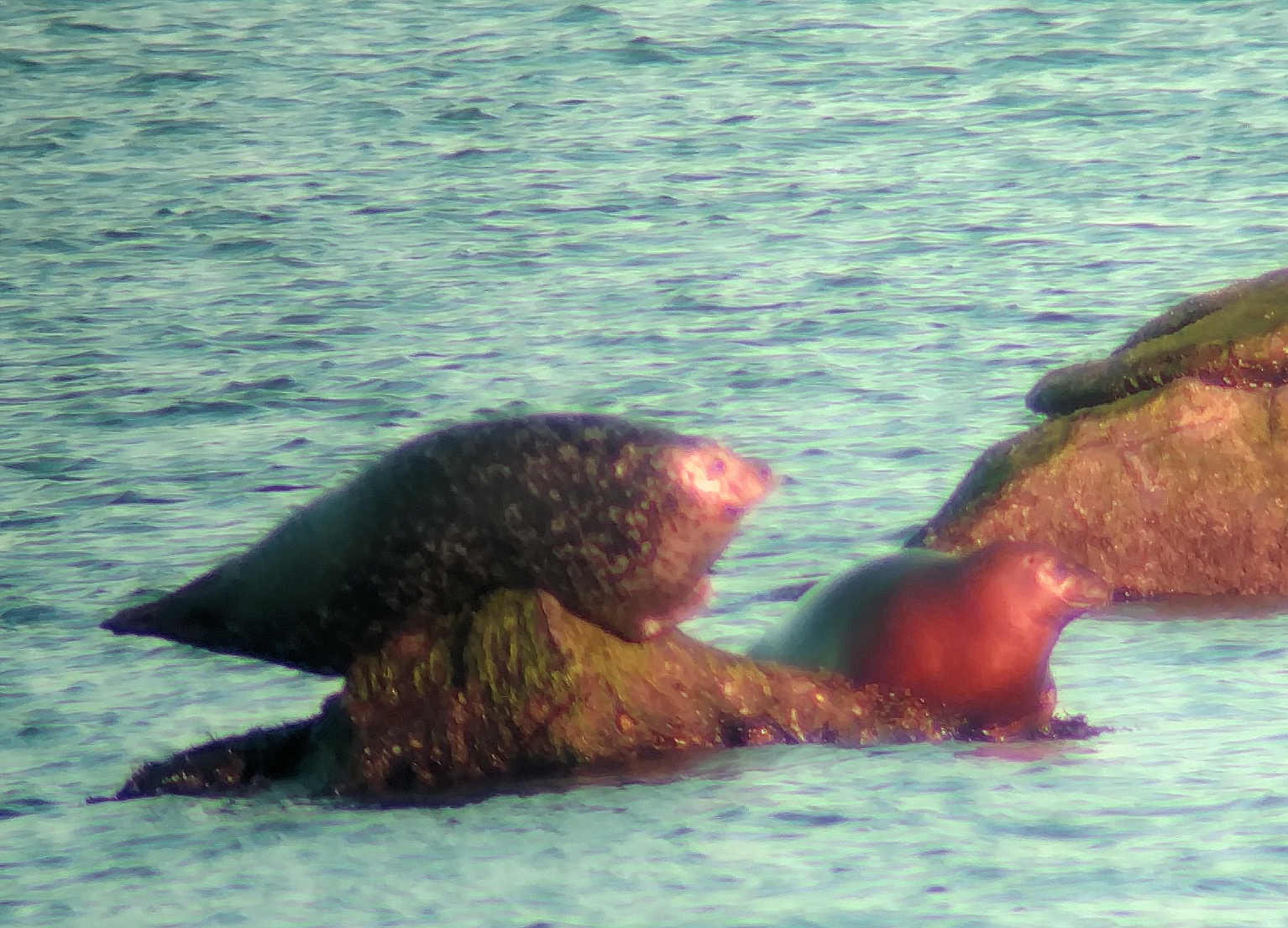
At about 14:00, we noticed the seals higher up on the ridge rock turning around to leave their perch, so we scanned the bay, expecting to see a boat or kayak approaching the rocks. We were surprised to see no watercraft in the area, and even more surprising was the speed with which the entire seal herd took to the water. The seals were clearly frightened more than usual, as they moved far from the rocks quickly without surfacing and only came up to survey the situation when they were a good quarter-mile out in the bay. We see the seals flush from time to time for no apparent reason, but I can't recall any time when they fled so far, so fast, and with such fear without good cause. For about 15 minutes no seals came back and we were afraid our seal watch was over for today, but eventually some seals slowly returned to the rocks, much to the delight of the many seal watching families who were out for a Sunday seal hike. Over the next hour and half, we shared a delightful seal watch with numerous seal watching friends old and new joining us on the beach for a great views of about 23 wild harbor seals.
1-14-2017 23 seals hauled out, 30 degrees, SSE 15 to 5+, cloudy, 15:00
5 seals on far rock for 28 seals total. Unusual weather led to an unusual but interesting seal watch today, as the passage of a warm front through the area right at the time when the seals should have been hauling out affected the seals' behavior. It has taken many seal observations for us to discover the various ways the seals respond to a sudden change in the weather and wind, as this does not often happen at precisely the right time to have an obvious effect on the seals. Today, it was immediately clear that the seals were very unsettled and relatively scarce well past their usual haul-out time, as seals came and went from the rocks in a fashion contrary to their usual hauling out behavior. One minute there would be a dozen seals hauled out, then a minute later, most of the seals would be back in the water. This continued on and off until about 14:00, when about a dozen large seals arrived and settled relatively quickly on the south rocks. By this time the rocks were well out of the water, so we were treated to the sight of some big seals clambering awkwardly up the rocks, as well as one lengthy territorial dispute involving 4 seals all interested in a favorite low-lying rock. The visiting seal hiking families were mostly late arriving today, as were the seals, and we enjoyed a sociable and entertaining seal watch in the late afternoon.
1-12-2017 64 seals hauled out, 54 degrees, SW 15 to 20+, clear, 14:00
3 seals on far rock for 66 seals total. We could not resist a quick seal hike today, as we found temperatures in the mid-fifties too enticing to resist on a January day. We were late for the tide and the light was not too good, so the seal watching was rather unremarkable, but as always the natural world worked its soothing magic on a heart that is aching from a recent family tragedy. Today was more about a reflective, pensive walk in the woods than it was about seal observation, and we were not surprised that once again a hike to see the seals suited us to a tee, circumstances notwithstanding. We were pleased to see there were a good number of seals around, which was good enough in itself for this day as we look forward to the upcoming MLK day holiday weekend seal watching.
1-2-2017 72 seals hauled out, 44 degrees, NW 15 to 20+, clear, 15:30
The best seal watch so far this season, with active seals, plenty of seal watching company, and even a skilled, considerate kayaker who did his best to avoid spooking the seal herd. There was a lot of action in the water as the seals arrived, with a half dozen different seals taking to the air in a variety of gleeful jumping exhibitions. The flat rock on the right was filling up with the usual suspects when a big Grey seal suddenly hauled his 600 pound self onto the rock, sending the smaller adult harbor seals fleeing back into the water. It was a treat to see the first Grey seal of the season, but the big fellow perhaps felt offended by the harbor seals that shunned him as he quickly returned to the water and did not haul out again.
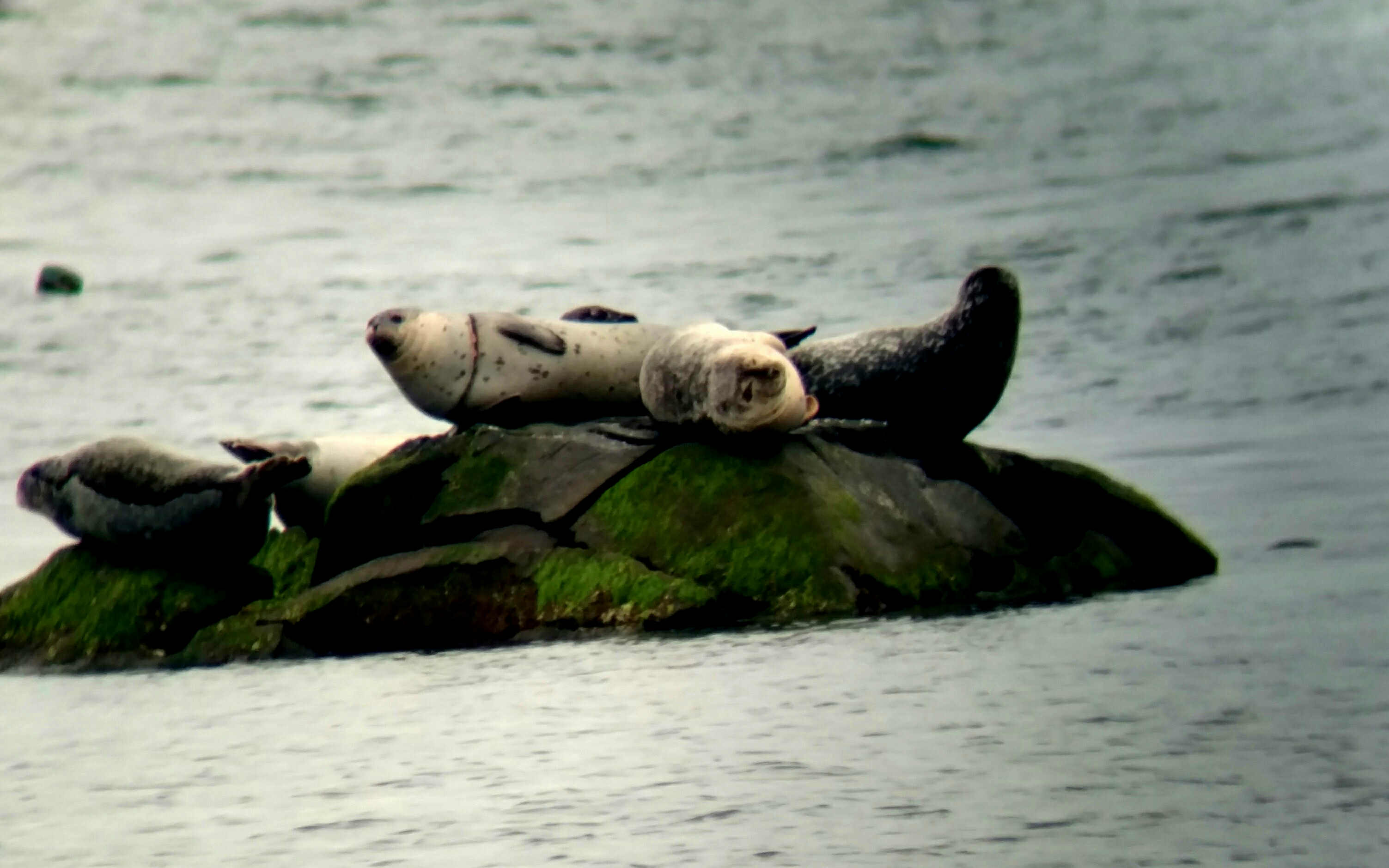
From time to time we observe seals with "necklace" scars from net entanglements; sometimes, the netting is still present wrapped around the seal's neck or torso. We can identify some seals that have this characteristic wound, and there is a seal with a distinctive double necklace scar that we have been seeing regularly for the past three years. The seal shown below is one we saw for the first time today; it appears that this animal has been wearing its "necklace" for a long time, but seems to be an otherwise perfectly healthy animal..
1-1-2017 No seals hauled out, 35 degrees, NW 15 to 20+, clear, 12:45
Some exceptionally stupid and reckless kayakers, who did not possess either the equipment or skill to be out on the bay in the winter wind (and who have flushed the seals on other occasions), chased all of the seals away 3 hours before low tide this afternoon. We have little quarrel with well-equipped, skilled winter water sports enthusiasts who may inadvertently flush the seals from time to time, but today's performance was quite disappointing, especially for the many seal seeking families who did not get to see the seals because of the foolish, inconsiderate behavior of the clueless kayakers we watched today. In six visits to Rome Point this season, we have seen the seals flushed on four occasions, and we are not going to trouble ourselves or visitors to this website with a running commentary on this subject anymore. In the future, our remarks will be brief when the seals are harassed and chased from their resting rocks, we have seen and commented on this troublesome, tiresome topic more than enough.
12-31-2016 70 seals hauled out, 38 degrees, SW 10 to SSW 15+, cloudy, 13:15
7 seals on far rock and 1 at Greene Point for 78 seals total. Very good seal observation today, with lots of seals and seal watchers, plus excellent optical conditions for close-up telescopic viewing. We were treated to our first Linebelly sighting right away, which had us exclaiming out loud with happiness at seeing our long-time favorite seal once again this season. This sighting marks the tenth season that we have spotted the venerable, honorary king of the Rome Point seals perched regally on his pointy rock throne.
Unfortunately, Linebelly's reign today was interrupted around 1:20 by intruding barbarians in the form of a boat out for a seal watching cruise. The boater did not approach the seals excessively closely, but a southerly wind tends to make for anxious seals, and about half of the seals in the center of the group flushed when the boat throttled down to take a look. This left us with 45 seals to check out for the rest of the afternoon, but the remaining seals were well-posed for observing through the scope; so much so that we barely missed Linebelly and the rest of the nervous seals that departed early this afternoon.
12-25-2016 58 seals hauled out, 34 degrees, W 10 to NW 15, clear, 12:00
A pleasant Christmas seal walk today, with warm sun making for comfortable conditions south of our usual observation location out of the brisk wind. We had limited time for seal observation with our Christmas schedule to attend to, so we had to leave before the afternoon seal watching rush hour, but we did get to share good views of settled resting seals basking on the rocks with several families. The most interesting observation of the day was on the pointy rock, where a smaller seal took up station on our old buddy Linebelly's favorite perch. The Rome Point old-timer was late to the party last season, so we remain hopeful that he will once again grace us with his presence in 2017. We have seen about 8 seals that we recognize from past years so far this season, but it is always a treat when we have our first Linebelly sighting of the year, as this seal has been hanging out at Rome Point for at least the past 9 years, and his regal perch upon the pointy rock has served to make him a favorite of many seal seekers over the years.
12-3-2016 25 seals hauled out, 45 degrees, NW 20 to 15, clear to partly cloudy, 15:30
An unusual and entertaining seal walk this afternoon, that got off to a slow start with only three seals hauled out under windy and splashy conditions. As the unsettled seals came and went, we noticed a large raft of ducks beyond the rocks, and when we zoomed in we saw by far the largest aggregation of red breasted mergansers that we have ever observed. The duck flock numbered over 200, all paddling north in about a half mile long line against the tide and the wind. When we turned our attention back to the few seals hauled out on the center cluster, we noticed that one seal had an unusual large, ragged wound on its back. When the seal turned sideways, we saw a series of four evenly spaced, two to four inch, vertical wounds on its posterior right flank. We can never be sure, but this looked just like the sort of wound that might result from narrowly escaping a shark attack, and we will be keeping an eye out for this seal, with its readily identifiable scars, in the future.
After about an hour, the wind abated somewhat, and more large seals began to haul out. The late arriving seals provided the best seal observation of the day for an enthusiastic group of URI coeds, who provided a sociable spark to the end of our seal watch today. The social media savvy young women snapped photos of seals through the scope with their phones, which no doubt were insta-grammed or posted in whatever manner is fashionable these days. The highlight of this activity was when one young lady was face-timing with her mom, and held her phone up to the scope so her mom could see the seals. We all heard her mom's excited exclamation as the seals came into view on her screen, which punctuated the first, but undoubtedly not the last, live-streamed seal pod cast from the shore of Rome Point.
11-26-2016 9 seals hauled out, 45 degrees, NE 10 to 20 cloudy, 11:30
6 seals on far rocks for 15 seals total. When we arrived at the beach 1/2 mile south of the seal watching site, the sight of a boat, 4 kayaks, and only a couple of seals at the haul out rocks had us muttering under our breath in disapproval. We decided to continue north up the beach anyway, which turned out to be a good idea, as a small group of seals returned to the rocks to pose nicely for the viewing pleasure of a the friendly visitors who joined us on the beach around noontime. One of the seals had a serious net entanglement problem with a yellow nylon rope clearly visible encircling the poor seal's neck so we will be keeping an eye on this large seal to see if it manages to survive it's unfortunate misadventure. Some seals live for years after a net entanglement with only a permanent necklace-like scar to show for their trouble, while other seals are surely not so fortunate; in most cases, we are unable to be sure of the fate of seals we have seen tangles up in rope or netting.
First Fall 2016 Seal Walk 11-25-2016 60 seals hauled out, 45 degrees, NE 10 to 15 cloudy to drizzle, 10:30
5 seals on far rocks for 65 seals total. We took a chance on the weather this morning and were rewarded with a brief but enjoyable first seal observation of the season. We were greeted with a round of welcoming vocalization, and had a good chance to get close up looks at all the seals in good light, allowing us to identify a half-dozen seals that we recognized from last Spring. As we chatted with a visiting family, the seals on the flat rock flushed, as they spotted a lone kayaker before we did. The paddler stayed close to shore and we were surprised when all of the seals took off; even more surprising was that only a few seals chose to return to the rocks. With a bit of uncomfortable drizzle in the air and most of the seals departing, we decided to call it a good short seal watch and headed for the parking lot sooner than we would have liked on a holiday Friday.
3-26-2016 145 seals hauled out, 40 degrees, NE 10 to 20, cloudy to clear, 15:00
5 seals on far rocks for 150 seals total. A very good seal watch today with great lighting conditions for the scope allowing us to zoom in closely to get great looks at the resting seals. While the seals and most seal watchers may prefer a sunny day, we are partial to cloudy days that provide the best optical conditions for telescopic observation. Days like today are especially good for identifying individual seals that we have noted before, and we quickly ascertained that Specklebelly was right back on the same rock as yesterday. We were able to spot another half-dozen seals that we recognized from observations in previous years, and now with some of our past photos archived on our smart phone, we have greatly upgraded our capacity for identifying individual seals. As the chilly northeast wind picked up, the conditions on the beach became uncomfortably cold, and we were almost relieved when most of the seals flushed at 3:55, putting an end to a fine Saturday seal watch.
3-25-2016 130 seals hauled out, 60 degrees, SW 10-15, cloudy, 15:00
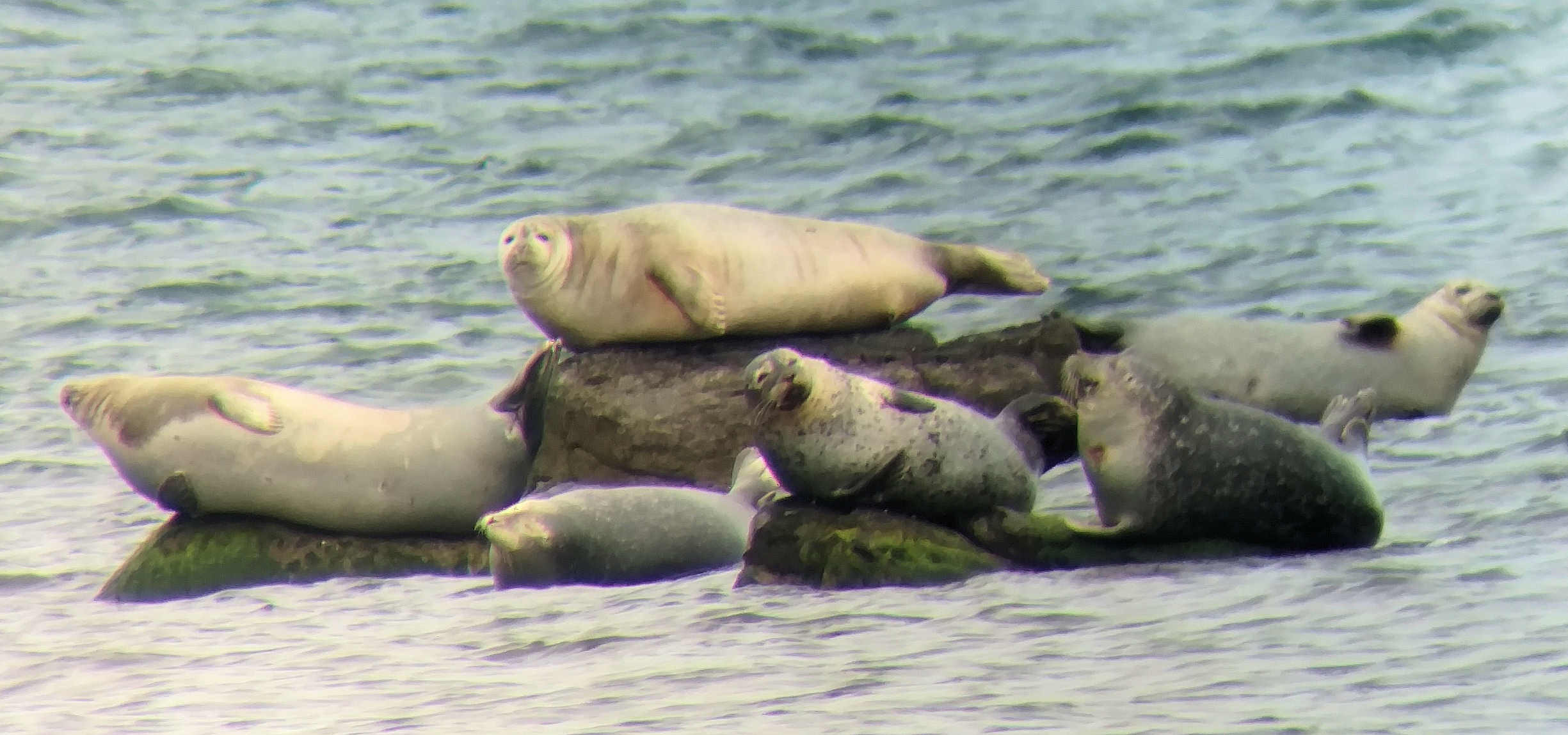
6 seals on far rocks, 6 at Greene Point for 142 seals total. The seals were already settled when we arrived and we only had time for a brief observation on this Good Friday. I had my granddaughter along on our seal hike today, and we decided to pick out a distinctively-marked seal to see if we can identify this individual animal repeatedly in the years to come. We selected a smaller seal with a lot of dalmatian-like spots, and she chose the name "Specklebelly" for our newly named friend. The photo below shows Specklebelly perched in front of the Table rock, with a distinctive clump of spots visible that will serve to aid in the identification of this seal in the future.
3-23-2016 135 seals hauled out, 60 degrees, W 10 to calm to S 15, hazy to clear, 14:00
11 seals on far rocks, 9 at Greene Point for 155 seals total. Exceptional seal watching with active seals that put on several good seal shows over the course of the afternoon. A lot of seals spooked off the center area around 12:35, and this triggered an active period for 1/2 hours as the seals got re-settled. This activity exposed Big Red on the center rock and as surrounding seals jostled for comfortable positions the Grey seal regaled us with his musical vocalizations as he expressed his displeasure with his neighbors. At one point, a couple of harbor seals used Big Red for a pillow, and he let them, and us, know with his mournful cry that this was not acceptable.
After the wind picked up out of the south, the seals started leaving, culminating in a fairly rapid departure at 3:20, when the remaining 50 to 60 seals all took to the water at the same time. Something about a south wind makes the seals behave in an erratic manner, and the sudden, simultaneous departure we witnessed today was unusual behavior that we have seen only occasionally. However, when this happens it is almost always when the wind picks up sharply out of the south some time after low tide.
3-20-2016 101 seals hauled out, 40 degrees, NE 15 to 5, partly cloudy, 12:45
7 seals on far rock for 106 seals total. A challenging seal watch today with the chilly easterly wind, but still very good seal observation featuring especially good light for viewing the seals close-up through the scope. When we first arrived, the inescapable cold wind was sufficiently uncomfortable to make us think that this would be a brief seal observation session, but as more seals arrived with associated interesting behavior and a steady stream of seal watchers came and went to keep us company, we powered through the chill and stayed on the beach most of the afternoon. All of the entertaining behaviors we see when there are a lot of seals in the area were displayed at one time or another, and the seal herd was less settled that they had been the two previous days. We happened to be watching closely at 12:55 when the seals started to scan excitedly and assumed more alert postures, indicating that they were about to flush into the water. Whatever the imagined they saw was not apparent to us, nonetheless, about 70 seals took a swim as the contagion of nervous excitement overcame the herd. Most of the seals were quick to return to the rocks, and the previously unoccupied flat rock was covered with large seals as the group settled in for an extended nap. As the cold wind died down, we settled in as well for an extended seal watch that lasted much longer this afternoon than we would have expected, given the harsh conditions when we set up at 11:00.
3-19-2016 150 seals hauled out, 45 degrees, NW 15 to calm, clear, 12:45
7 seals on far rock for 157 seals total. The hits just keep on coming as we enjoyed seal observation today that somehow managed to surpass the great seal watching of the previous two days. We watched the seals arrive and haul out with a great deal of associated aerial acrobatics, and one seal performed 8 consecutive jumps out of the water in an amazingly athletic sequence. The March Madness continued with the first flirtatious behavior we have seen this Spring, and plenty of sporadic territorial squabbles to keep a steady stream of seal seeking onlookers continuously entertained. At 1:05, the seal herd flushed for no good reason, which shuffled the seal deck sufficiently to bring on another round of active behavior, As the seals returned to the rocks, we heard the sound of Big Red the Grey seal as he wailed in displeasure at the neighboring harbor seals that had encroached on Red's personal space, and we watched as the big guy threw his weight around a little bit to secure an acceptable resting place. There was a second Grey seal on the cluster rock to keep Big Red company, yearling seals posed for all to see, and 90 harbor seals hauled out until late in the flood tide on this exceptional Saturday seal watch. We were especially pleased that no one in a boat or kayak saw fit to encroach on the seal's resting rocks as the wind faded and sunshine beamed down, making this an exceptional, and much appreciated, Saturday seal watch for everyone who made it out to Rome Point today.
3-18-2016 122 seals hauled out, 54 degrees, W 15 to 20, cloudy, 11:45
5 seals on far rock for 127 seals total. Another outstanding seal watch this morning, with lots of seals showing their customary tolerance for the gusty west wind, and fine light for the scope. "Wind from the west, seals like it best" proved to be true once again, and there were still additional seals arriving when we had to leave. For reasons known only to the seals, when the wind blows from a direction that the seals favor, they are less fussy and anxious than they are on calm days, which was evident today as the seals rested soundly in spite of the blustery wind and splashy waves. This stood in contrast to yesterday, when the seals spooked three times of their own accord while they should have been relaxing as a calm wind changed to a gentle, warm southerly breeze.
The seals jostled around a bit and there were several territorial battles, but for the most part the seals enjoyed a peaceful morning of rest. Big Red the Grey seal was hauled out on the north end of the rocks, Linebelly was on the pointy rock, and we recognized a good number of the usual suspects on the flat rock and mound. There are two easily recognizable seals with net entanglements that we have been observing for weeks, one of which has a distinctive double netting necklace. This was a very good seal watch, and we were dismayed that other responsibilities forced us to leave while there were still so many seals hauled out, as its not every day that we get to see this many seals under the excellent light for close-up telescope observation that we enjoyed today.
3-17-2016 146 seals hauled out, 50 degrees, Calm to S 5+, hazy to clear, 10:00
7 seals on far rock for 153 seals total. Exceptional seal observation this morning with a lot of seals hauled out under neap tide conditions. On a neap tide, the water level remains relatively high at low tide, so many of the lower rocks stay under the waterline. This does not bother the seals at all when it is calm, and today there were about 90 seals hauled out on submerged rocks in the "banana" pose when we arrived. As the tide dropped, these seals came out of the water and more seals hauled out on additional rocks as the decreasing water depth made new rocks accessible.
One seal that can have any rock that it chooses is our old friend Big Red the Grey seal, who made his annual springtime appearance at Rome Point today. This time Big Red, who is about a foot longer and over 100 pounds heavier that the largest harbor seals, selected the far right flat rock for his bed and no seals saw fit to challenge him. However, at 10:10 the entire seal herd suddenly spooked for no apparent reason, as is par for the course on calm days when there are over 100 seals on the rocks. Unlike when people scare the seals, when the seals flush due to their own mistaken anxiety, many of them will usually return to the rocks in short order after they realize there was no real threat present. This often results in a lot of seal interactions as they reclaim their resting spots, and today Big Red ended up in the middle of a fracas on the flat rock. As the seals jostled and snapped at each other, Big Red commenced to express his displeasure with the distinctive, plaintive song of the Grey seal, which is the siren song of lore that we are always thrilled to hear. Grey seals in general may not be as attractive animals as harbor seals are, but when their song is heard clearly on a calm day, the sound ranks right up there with the cry of the loon or the howl of the wolf as a most remarkable call of the wild.
After the seals re-settled, they spooked two more times while we we there, at 11:05 and again at 11:15. On each occasion about 50 seals returned to the rocks, but by 11:30 the seals were on the move as the fast rising tide covered the rocks. One group of seals who was not going anywhere were the 7 big seals on the far rock, who never showed any signs of alarm as a boat tended the nearby oyster aquaculture racks. We were concerned that this new aquaculture setup might displace these seals from this haul-out location, but our concern proved to be unfounded, and the boat operators are obviously taking care so as not to unduly disturb these seals that share the bay with their oyster farm. Good on them and the other oyster farmers who use this area, as they have proved over the years to be responsible stewards of all the marine wildlife at Rome Point. That said, 7 seals in a group are much more tolerant than the large seal herd that hauls out off of Rome Point, so we hope the permitting powers-that-be are aware that there is no room in this immediate area for any more aquaculture operations, lest the seals be permanently displaced by a commercial venture.
3-13-2016 8 seals hauled out, 58 degrees, Calm to S 10+, clear to hazy, 15:00
8 seals on far rock for 16 seals total. A disappointing seal watch today, as the seals were spooked off the rocks by a small power boat shortly before we arrived. The seals that remained in the area were very nervous, and never did settle down, which is an indication that the boat must have hung around for a while and scared the seals fairly badly. The far rock must not have been approached by the boat, as it was packed with 8 large seals; no doubt the haul-out rocks at Rome Point would have been similarly loaded with seals had thoughtless humans not interrupted their rest.
Fortunately for the numerous seal seeking families who were out on this nice Sunday afternoon, one or two seals remained well-positioned on the south rocks so that people still had a few seals to see. It is always interesting to see the way people react to the seals, and how for people seeing seals in the wild for the first time through our good scope, the sight of a half-dozen seals is quite fascinating and satisfying in terms of making their seal hike a success. We are thankful that this is the case, but on a day like today these first time seal watchers are fortunate that their happiness is undiminished by the knowledge of what they have missed in terms of numerous seals and interesting behavior. There would have surely been at least 100 seals on the rocks today if they had not been scared away, and we wish we could have shared that experience with the visitors, instead of just a few nervous seals.
At 4:00, a group of kayaks approached the rocks, flushing the few remaining seals and ending our seal watching for this day. Three of these kayaks were the same group that spooked the seals on 2/20, and we doubt that they saw any of the seals that left the area hastily after being disturbed for the second time today. They were obviously looking for the seals, and although we doubt this clueless group had any notion of why they saw no seals on this excursion, we took some satisfaction that they received some of the very medicine they doled out to shore-based seal watchers back in February. However, this second seal disturbance incident in a single nice day may be a foreboding sign of things to come this spring on weekends when the weather is, as we have become accustomed to saying, "too nice" for good seal observation.
3-12-2016 22 seals hauled out, 54 degrees, S 20 to 15, then SSW 10, cloudy, clear, 15:30
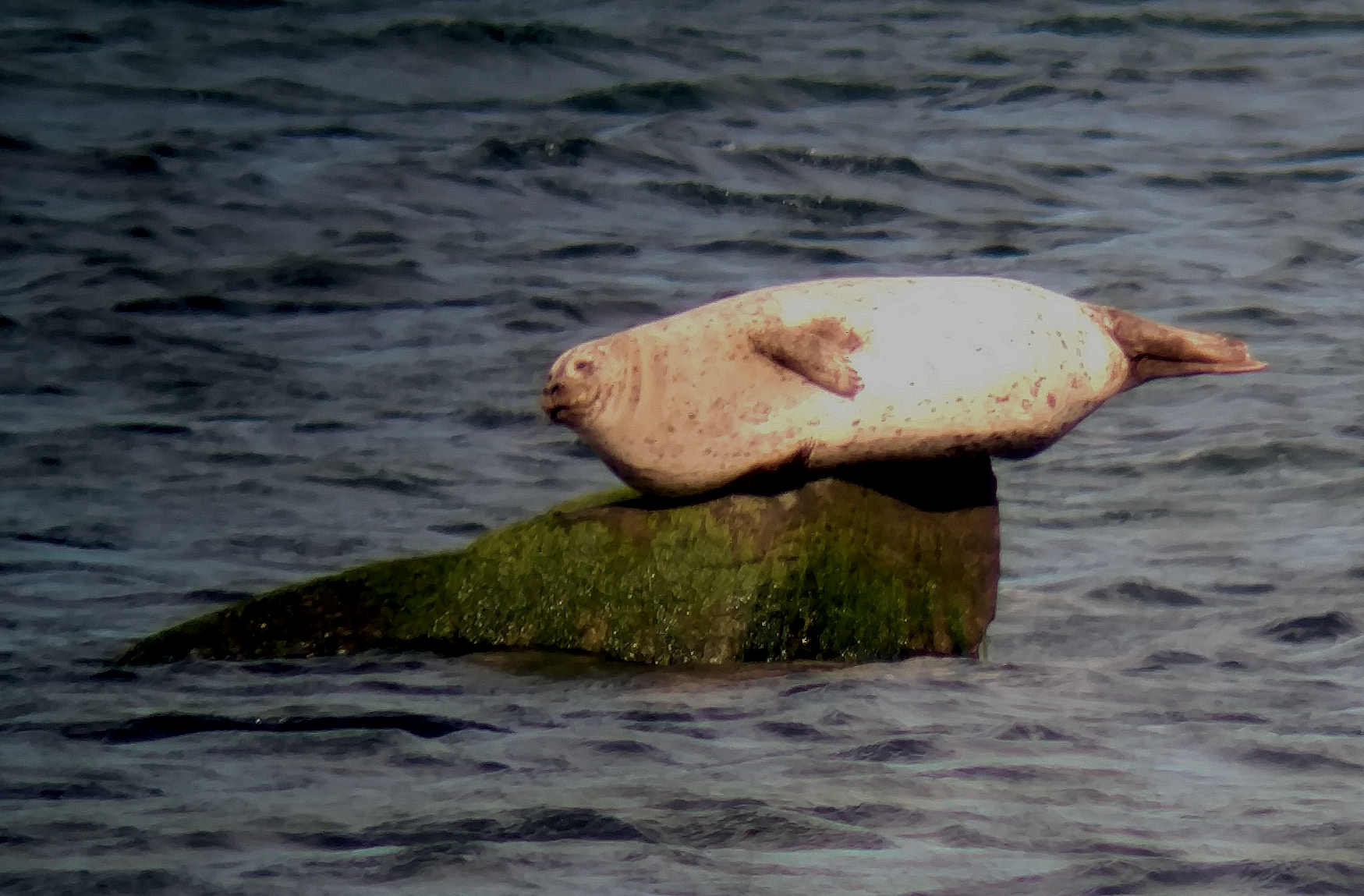
1 seal on far rock for 23 seals total. A blustery wind straight out of the south is not good for seal watching, so we were happy to see as many seals as we did this afternoon. There were seals on the tall rocks and ridge rock when we first arrived, but these seals tired of the annoying wind and ended up hauled out on low rocks. One seal with dalmatian-like markings was the star of show today, as he perched on the slanted rock on an amusing position all afternoon. The light for the scope was very good and a fair number of weekend visitors got nice close-up looks at the seals that did show up, but there was only briefly interesting behavior to entertain onlookers, and unfortunately, our seal watch today was nowhere near a good as our observations for the previous two days.
This seal was everyone's favorite today and to commemorate his rock-star-for-a-day status we are posting the photo below.
3-11-2016 122 seals hauled out, 56 degrees, NW 20 to 5, then N 10, cloudy, then clear, 14:00
6 seals on far rock for 128 seals total. We did not know what to expect with the conditions on the bay so different than yesterday, and there were only 4 seals hauled out, with a much higher tide than we anticipated, 2 1/2 hours before low tide. For about 15 minutes we thought seal watching was going to be a bust, but then a couple of seals hauled out on the ridge rock, followed shortly thereafter by another pair of seals who wanted to fight over who would get the desirable ridge rock. Suddenly we were off to the races when seals popped up everywhere as the wind abated, and we enjoyed outstanding marine mammal observation for the next 2 hours as the seal herd took up their positions on the rocks. There were almost continuous loud and feisty territory squabbles, a fair amount of jumping and splashing, and the always amusing sight of the seals hauling their fat selves up on their chosen resting rocks. After all the seals sorted out who got which rock, it was lights out for the entire herd and the seals settled easily into their heavy rest mode for the rest of the afternoon.
3-10-2016 116 seals hauled out, 44 degrees, SSW 10 to SW 5, cloudy, 12:00
4 seals on far rock for 120 seals total. A very interesting and active couple of hours on the beach featuring the most seals we have seen so far this season. The weather was kind of unusual, with a frontal boundary just to the north and warm, almost muggy conditions blowing in on a southerly breeze. This goofy weather combined with a new moon astronomical low tide to make for an unpredictable seal watch that had a lot of unsettled seals, poor light for the scope, and a quickly changing variety of marine mammal behavior to observe. I can usually do my postings here from memory, but so much happened in quick succession today that I have to consult my written notes to accurately describe this seal watch.
When we arrived there were over 100 seals already hauled out, with seals on every rock and many congregated in the center area of the rocks. There was a good deal of vocalization and several territorial skirmishes as more seals arrived to join the group that was already on the rocks. The associated commotion kept the seals from settling down and they scanned frequently. At 12:10, about 60 seals in the center of the group spooked for no apparent reason, as happens frequently when there are more than 100 seals hauled out. When the seals have an anxiety attack and there is no actual impending threat, they will usually return to the rocks with some attendant fanfare, and this occurred true to form. For a while there were frequent but brief battles for the most desirable rocks as about 40 seals came back to haul out again. One seal porpoised 7 consecutive times in profile right in front of the rocks, putting on a handsome display of powerful athleticism.
The seals had difficulty settling down with frequent scanning, so we were not surprised when the seals spooked again at 1:30. This time however, there was a boat tending the oyster racks at the aquaculture set off the SE point of Fox Island, and it appeared that the seals may have been looking in that direction, so perhaps a noise from the maneuvering boat could possibly have disturbed them. Still, a good number of seals on the center cluster and flat rock remained undisturbed, and only a few of the seals that were spooked returned to the rocks, which makes us believe that the boat did not disturb the seals. Even if it did, the conditions today were so atypical, the seals were unusually anxious, and the seals have not been bothered by this boat in the past, so this should not be an ongoing problem... or so we hope. In any event, all of the seals were spooked 20 minutes later by a pair of paddleboarders, and there was only one seal remaining on the rocks when we left at 2:00.
3-6-2016 75 seals hauled out, 34 degrees, N 5, clear, 11:45
1 seal on far rock for 76 seals total. Much improved seal observation on this busy Sunday, with numerous seals, an agreeable light north breeze, and better optical conditions for high magnification viewing through the scope. There were two separate large groups of seal watchers who joined us on the beach today, so this day probably had the most small children who have ever seen the seals through spotting scopes. The kids' reactions to using a high quality telescope (often for the first time in their lives) and seeing seals in the wild are frequently more entertaining than the seals themselves, and we had a great day sharing our seal watch with all of the nice families who hiked out to Rome Point today.
The seals showed a fair amount of interest in the busy goings-on on the Rome Point shore, and did not settle into a deep rest mode until later in the afternoon when the noise and activity on the beach lessened with the departure of the second group. There was a lot of scanning behavior from the seals, especially during times when some of the children were being a bit rambunctious, but with a north wind the sound of voices from the beach did not carry out to the rocks particularly well. A north wind often makes the seals unsettled anyway, and none of the seals were sufficiently rattled to spook into the water, but it was clear that the seals were aware of the presence of a sizable group of onlookers on the shore. Under different conditions when there are more seals present, we might need to gently remind large groups to keep the noise down to avoid unduly disturbing the seals, but today this was not a problem at all, just a reminder to us that we need to pay close attention to how the seals are reacting to relatively large numbers of seal watchers on the beach. We do not want to have a seal disturbance incident resulting from activity on the Rome Point shore, so today served as a good wake-up call for us to stay alert to the seals' behavior on weekends when there are a lot of people around.
3-5-2016 16 seals hauled out, 30 degrees, N 15 to 20, clear to hazy, 12:00
Not so many seals out today due to a persistent North wind, but an enjoyable, albeit chilly seal watch nonetheless. We were joined on the beach by a large contingent of seal seeking families courtesy of our friends the Rhode Island Families in Nature group. Everyone enjoyed good views of the seals hauled out on the ridge rock, and later, the flat rock. There was always some activity when seals came and went from various rocks as the gusty wind made their selected perches too splashy for comfort. The seals never settled very well as the wind kept on blowing, so it was a morning of fitful sleep at best for the seals today.
The best of the seal observation took place after the group departed, when the big seals that hauled out on the flat rock late in the ebb tide were displaced by the rising tide. These late arriving seals were not content to give up on their nap time so soon, and several of the flat rock seals decided to conduct an insurgency against the seals that were resting peacefully on the ridge rock. Some of these bigger seals took over the ridge rock over the course of about 10 minutes, driving all of the previous occupants to less desirable rocks. Other seals from the flat rock had a different idea, and the sight of these large seals awkwardly clambering up onto the left tall rocks was both amusing and unusual. This late flurry of interesting seal activity served to remind us once again that the quality of the seal watching experience is not so much dependent as how many seals are around; rather it is the seals' behavior, and puzzle of figuring out what conditions or motivations dictate the seals' actions are what makes seal observation fascinating over the long term
2-21-2016 90 seals hauled out, 52 degrees, W 10 to 15, hazy to partly cloudy, 13:00
5 seals on far rock for 95 seals total. The best seal watch of the season so far today, which was about as good as it gets for mid-winter seal watching. There were seals on all the rocks when we arrived, including some large seals on the tall rocks, which is a sign that the seals were tired and hauled out early. We got there too late to see the interesting haul out behavior, but at 12:30 about 60 seals spooked for no apparent reason, as happens often when there are a lot of seals on the rocks. When the seals get anxious and go for a swim on their own accord, they will almost always return to the rocks, which usually triggers a period of territorial behavior and some splashy frolicking in the water. This happened today with a lot of onlookers present, much to the great interest and entertainment of all the lucky seal seekers who timed their arrival on the beach just right. As the tide came in, sporadic vocalizing and flipper slap fights were observed as the rising water caused the seals to slosh into one another occasionally. We stayed late into the afternoon, and were glad that we did, as even late-arriving families got a chance to see a decent number of seals three full hours after low tide.
There were a lot of visitors to the Rome Point beach today, and they should all be glad they enjoyed such a pleasant nature experience, as visitors who came out on Saturday were not so fortunate. We kept waiting for the other shoe to drop and for the seals to chased away by some hapless interlopers, but on this Sunday the seals were left alone to bask in peace. We are most thankful for that, and grateful for every weekend day when the seals are left to rest undisturbed. We are long past taking good weekend days for seal observation for granted, as we have seen the seals spooked off the rocks many times on nice Saturdays and Sundays. There was one year about 5 years ago when we even stopped hiking out to Rome Point in late March and April on the most calm, temperate, weekends because it had become a sure bet that the seals would be scared away. That situation improved greatly for some reason in subsequent years, and we are hopeful to see more days like today... and no more days like yesterday... as we move into the prime of the seal watching season.
2-20-2016 57 seals hauled out, 45 degrees, SW 10 to 15, clear to hazy, 11:30
We got hung up with chores at home today and were delayed in our seal hike departure, which, unfortunately we later had cause to regret. At 11:40 a trio of female kayakers paddled directly to the rocks, spooking every seal from their resting place within 10 minutes of our arrival. The kayakers compounded their thoughtless actions by remaining around the seal rocks for almost 1/2 hour, driving the seals completely out of the area. This was one of the more blatant violations of the Marine Mammal Protection Act that we have witnessed in recent years, and the offending kayakers possessed neither the equipment, knowledge, or skill to be out on the bay in winter conditions. Two of the paddlers were using 8 ft. sit-in kayaks, which I would not take out in the bay myself in the summer, and I have advanced paddling experience. They did not appear to be wearing wet suits or dry suits, and I hope they at least had PFDs under their heavy outerwear, which would have become a waterlogged anchor in the event of capsizing. They also paddled close in and among the rocks, which was fine (from a paddling safety standpoint) as long as the tide was running out. However, as soon as the tide turned, wind/swell driven waves started breaking in the rocky shallows, which I am sure none of those kayakers would have anticipated. I, however, expected this to happen with the fresh southwesterly wind, and if those waves had started breaking about 20 minutes sooner, we may well have been witness to a bad situation on the water today.
I could tell the seals were gone for the day, but I had packed a lunch and planned for a long seal watching outing, so I stayed on the beach for almost an hour after the kayakers departed. Around 12:30, a pair of paddle boarders passed between the haul out rocks and the shore, which likely would have spooked the seals had they been present on the rocks. These is a difference between spooking the seals inadvertently and blatantly chasing them from the rocks in our opinion; moreover, paddle boarders passing by without stopping are unlikely to drive the seals completely from the area, as we have often observed the seals returning to the rocks when the intruding watercraft leave the area immediately. Our last observation of the day was a pair of responsible, knowledgeable kayakers who gave the seal rocks a wide berth as they paddled well outside the seals' safe zone. Oh, there was one more observation... we counted 55 cars parked at the trailhead when we left, and all of the many families who hiked out to Rome Point to see seals on a beautiful Saturday afternoon were disappointed that there were no seals to see, thanks to the ignorant and illegal actions of the kayakers we videotaped today.
2-19-2016 52 seals hauled out, 42 degrees, NW 10 to calm to S 10, clear to partly cloudy, 12:30
7 seals on far rock for 59 seals total. Typical seal watch with seals on most of the rocks except for, curiously, the usually popular flat rock. For reasons known only to the big seals that usually haul out on this prime real estate, the flat rock remained empty for most of the time that we were there. A pair of seals did settle there after low tide, but the usual suspects were not home on the flat rock today. We have seen this before when the south wind kicks up, but not on a relatively calm day like today. Otherwise, we enjoyed a nice seal watch with a good number of visiting families, but once again the seals were in a mellow mood with not much in the way of active behavior on display during our somewhat brief visit.
2-18-2016 57 seals hauled out, 30 degrees, NW 15 to 25+, clear, 11:30
5 seals on far rock 62 seals total. Our seal watch today was surprisingly windy, with a steady NW wind that exceeded the predicted velocity by a good 10 knots. Fortunately,the seals will often tolerate a fresh northwesterly breeze, and they were undeterred by the weather conditions which were in sharp contrast to yesterdays April-like weather. So the seal watching was good with fine light for the scope, Linebelly on station, and juvenile seals perched on some of the high rocks. Not much notable activity among the seals, except they did tend to scan more frequently, especially during periods when the wind was howling. It was a bit breezy at our usual observation location, so we moved south slightly around the point to enjoy the benefit of less wind and more sun.
There were a few ducks in the water along the lee shore, and we noticed a red-throated loon also taking shelter there. Sadly, a close examination of the loon with the scope revealed the poor bird was severely entangled in heavy monofilament fishing line. This situation did not look like it was going to end well for the loon, as it was all wrapped up in the line,with several strands around its neck and line coming out of its mouth. There was also a seal with the characteristic "necklace" net entanglement on the rocks, but most likely the prospects for survival are much better for the seal than for the loon. We greatly enjoy recreational saltwater fishing, and it was a sobering sight to see firsthand how broken fishing line can adversely affect aquatic wildlife. Our friends at the Audubon Society of Rhode Island have placed boxes at numerous fishing access areas all over the state for disposal of used, tangled fishing line, and there is one on the beach at Rome Point. The vast majority of sporting anglers would never dispose of a tangled line in the water, but anyone who fishes knows that snags and associated broken lines are inevitable. We always make a game effort to free a snagged line and to minimize the length of line left in the water when we break off a line, but the sight of the loon in distress today caused us to wonder if a sea creature has ever got caught up in any fishing line that we regrettably left behind.
2-17-2016 82 seals hauled out, 42 degrees, W10 to calm to SW10, clear to partly cloudy, 11:30
2 seals on far rock for 84 seals total. What a difference 10 days make, as we put the memory of a drone spooking the seals in the past and enjoyed very good seal watching today. The seals appeared as pleased as we were with the fine weather, and we recognized a number of familiar seals, including Linebelly on his favorite rock. By the time we arrived the seals were well settled, but occasional vocal outbursts were heard and a couple of seals obliged us with some aerial acrobatics. We were joined on the beach by only three families all morning, but they all got close-up, unhurried looks at the seals in good light and well posed for viewing. With calm conditions on the bay, many seals lingered late into the incoming tide, later in fact than we were able to stay.
We did stay long enough to solve the riddle of what is going on out beyond the main seal haul-out rocks, off of the southeast point of Fox Island. The radar reflectors and buoys that showed up there this year mark another shellfish aquaculture operation, so apparently the water there is sufficiently shallow to conduct oyster aquaculture. The boat who was tending the racks did maneuver close by the rock we refer to as the far rock, but the couple of seals that were hauled out there paid no mind to the nearby activity. Still, this is a mildly troubling development, as with the ever-increasing popularity of aquaculture, we hope the powers that be in the aquaculture permitting world are aware of the importance of the Rome Point haul-out site. There may come a time when we will have to advocate for the protection of this unique natural resource, and the start-up of a new aquaculture setup within view serves to remind us that we need to be vigilant early in the fall ensure that commercial interests are not unduly encroaching on the Rome Point seals.
2-7-2016 30 seals hauled out, 44 degrees, calm to S10, clear to cloudy, 13:30
11 seals on far rocks for 41 seals total. A disheartening seal watch on a beautiful day due to the unfortunate presence of a foolish human who just could not resist the impulse to fly his drone over the seal rocks, thereby scaring the seals away. Not to be satisfied with spooking all of the seals into the water, the drone operator upped the ante on selfish idiocy by hovering above the haul out rocks for an extended time, repeatedly spooking the numerous seals who would have otherwise been inclined to return to the rocks. I am not going to drone on in this forum about drones except to say that hobbyist aircraft are not welcome at Rome Point nature preserve and those who deliberately harass the wildlife with their toys are going to have to contend with us in our uncharacteristic irate mode, which will most assuredly be an unpleasant experience that they will not choose to repeat.
At least the drone showed up early in the ebb tide, leaving ample time for the seals to return after the harassment procedures ended. It was obvious that the seals were shaken up by the drone's presence and they returned to the rocks very slowly despite the perfect conditions. With excellent light for the scope and some seals posing handsomely the seal watch was salvaged for a good number of seal seeking visitors who timed their visit to the seal beach fortunately between noon and 1:00. At about 1:15 the wind kicked up a bit out of the south, which made the beach more chilly and the seals more fussy, putting and end to our seal watch for this day.
We have been blessed to participate in hundreds of seal hikes over the past 17 years... almost 700 seal walks to be a little more precise. When the seals are spooked away by boats, kayaks, or now even drones, we usually take this in stride as we have enjoyed many wonderful wildlife observations all over North America, and have best hopes that we continue to be blessed with many more great nature experiences before we hang up the scope and binocs for the last time. That said, we also have an appreciation that nice winter weekend days when the weather and tide cooperate to make outstanding seal observation possible are somewhat uncommon and are certainly not to be taken for granted. Many other visitors to Rome Point are casual one-time visitors who just want to see the seals, and the happiness and wonder that children and grownups alike experience when they get their first close-up looks at seals in the wild is a joy and a privilege to participate in. Today, we had some family members accompanying us who do not get to visit Rome Point on a regular basis, which underscored how special these weekend seal watching opportunities are for those who do not devote a big part of their lives to nature observation as we do, and how disturbing it is when our outdoor interludes are intruded upon by the very human selfishness and cluelessness that we venture into the natural world to get away from. Over 40 years of hiking, floating, fishing, hunting, and tracking around in nature, there have been a mere handful of days when we were not left with a familiar feeling of contentment and happiness at the conclusion of our great or small outdoors adventure. Sadly, today was one of those days, and with a string of stormy days predicted for this week, it may be a while until we have a chance to get our happy nature groove on once again.
2-6-2016 60 seals hauled out, 38 degrees, SW 5-10, clear to cloudy, 11:45
5 seals on far rock for 65 seals total. A good seal watch today on a calm, temperate Saturday with extended seal observation hours facilitated by the astronomical low tide. We enjoyed solitary seal watching for the first hour or so of our visit, which was the best time to observe active seals. The seal showed signs that they were tired from a couple of days harsh weather, which is to say, they were not very active at all, it has just haul out then lights out for the worn out seals today. A good number of seals were well positioned for up-close viewing through the scope, including Linebelly, who has been making less frequent appearances on the pointy rock this season. Interestingly, there were no juvenile seals on the taller rocks, and we wondered where all the little seals were today.
As the afternoon passed, clouds and people both arrived on the Rome Point beach, and we were pleased to greet both the seal seeking families and the overcast conditions which greatly improved the light for telescopic wildlife observation. Those who arrived later in the afternoon were treated to excellent views of the seals, who showed no inclination to depart until the rising tide forced them from their resting rocks. The new moon extra-low tide was a welcome bonus for seals and seal watchers alike today, as the seals were allowed an extended rest, and seal watchers were treated to an extended observation opportunity. When we departed three hours after low tide, there were still over 40 seals hauled out; this only happens on rare occasions when the tide is extra-low, the seals are extra-tired, and the wind is especially favorable.
;
1-31-2016 50 seals hauled out, 45 degrees, SW 10-15, clear, 1630
2 seals on far rock for 52 seals total. Our seal observation got off to a slow start this afternoon, as the immature seals that often haul out early in the ebb tide chose not to grace us with their presence today. When we arrived a little after 2:00 pm there was only one seal hauled out, while another half dozen seals circled the still-submerged rocks, waiting for more rocks to rise above the splashy waterline. Good things come to those who wait, and the waiting game was easy enough today with the unusually warm temperature for the last day of January. At around 3:30, seal watching picked up notably, and for an hour we got to see a good seal show with active porpoising seals and big seals clambering up onto the low rocks. We stayed until after sunset as the seals in the center cluster engaged in sorting out their territory, with loud vocalizing that we could hear plainly even with the wind at our back.
1-30-2016 52 seals hauled out, 43 degrees, SW 10-15, mostly cloudy, 1630
3 seals on far rock for 55 seals total. A sociable Saturday seal watch today that was notable for occasional interesting seal behavior and a steady procession of seal seeking families who kept us company on the beach all afternoon. The juvenile seals were the stars of the show for most of the afternoon, as there were a dozen of the young seals perched high on the tall rocks early in the ebb tide for everyone to see. The southwest wind held the already lazy tide up in the bay so it took a long time for the lower rocks to become exposed and sufficiently less wave-swept to attract the larger adult seals. The ridge rock was the site of an exceptionally vicious seal fight that drew blood from one of the participants as a very determined large seal forced its way onto the crowded rock and put a hurt on one of the previous occupants. The injured seal had visible puncture marks in front of its left front flipper from the aggressive seal's sharp teeth, but despite getting bloodied in the fray the injured seal stayed on the rock without apparent grudge for the rest of the afternoon.
We observed a fair amount of porpoising behavior and a few other interactions, and we very much enjoyed hanging out with the numerous visitors who made their way out to Rome Point this afternoon. A late arriving pair of moms with a couple of young children and an infant in tow were fortunate that we stayed on the beach until the last minute as they got good views of the seals as well as a guided tour back to the parking lot in the fast-fading light. One bonus of staying until sundown was a gorgeous, golden sunset that bathed the back cove in a warm winter glow.
1-29-2016 62 seals hauled out, 38 degrees, Calm to W 10, cloudy, 1545
3 seals on far rock for 65 seals total. A real good seal watch this afternoon with calm conditions inspiring the seals to haul out early in the receding tide. There were a good number of adult seals high on the tall rocks to the left, which is an indication that the seals were eager to get some good rest after a stretch of windy weather that probably kept them off the rocks for most of the past week. Some of the seals that arrived late were quite active, and a few leaped out of the water repeatedly. The big seals on the flat rock were notably slow to settle, with several seals hauling out, returning to the water to jump and frolic, then hauling out again. We think that sometimes splashing and porpoising behavior may be a sign of frustration, but what these seals may have been upset about on this beautiful afternoon was not apparent to us. There was also a lot of vocalization which we could hear clearly across the calm water and after the seals settled around 3:30 we were treated to excellent views in the favorable evening light.
1-21-2016 60 seals hauled out, 35 degrees, NW 10-15, clear, 1100
5 seals on far rock for 65 seals total. The increase in the number of seals we spotted today was mostly due to the arrival of a contingent of immature, yearling harbor seals. The juvenile seals will soon find their place in the haul-out pecking order and will eventually be relegated to the taller rocks, but for now the little seals were scattered among the rest of the group. Immature seals spend more time on the rocks, generally arriving earlier in the ebb tide, and remaining later as the tide rises. This often extends the time period when seals may be seen on the haul-out rocks on any given day, so we are always glad to see the additional young seals arrive in January.
1-11-2016 45 seals hauled out, 40 degrees, W 10-15, clear, 13:00
5 seals on far rock for 50 seals total. An unusual seal set-up today with a good number of seals, but no seals on the southern-most rocks, including the prized flat rock. This resulted in several seal fights for good rocks in the center area, one of which was especially fierce and lengthy. A juvenile Grey seal joined the seal herd today, but the small Grey seals often keep their distance from the Harbor seals, so this solitary seal was the only seal hauled out on the south end of the haul-out rocks.
1-9-2016 48 seals hauled out, 45 degrees, NE 10, cloudy, 13:30
5 seals on far rock for 53 seals total. Very good seal watching today with excellent light for close-up telescopic observation and unsettled, active seals that held our interest for over four hours. We enjoyed hanging out with a continuous procession of seal seeking families, including a number of our long-time seal watching friends, which made this seal watch a sociable, happy affair. The northeast wind was not strong enough to affect the seal watching in an adverse manner, but it seemed to make the seals a bit anxious, as they were especially slow to settle and seals in the center of the haul-out rocks spooked for no apparent reason on two occasions. The big seals on the flat rock also spooked once, and when they finally returned to the rocks it took them a long time to settle down. The unsettled seals scanned and skirmished well into the flood tide before they eventually settled into heavy rest mode, and there was plenty of vocalization heard by the many visitors to the beach this afternoon. The seals stayed late into the incoming tide, as though taking advantage of the good conditions for resting on the rocks in anticipation of a stormy day forecast for tomorrow.
1-7-2016 47 seals hauled out, 40 degrees, Calm, clear, 12:30
We enjoyed the best seal watch so far this season today, under perfect conditions that lured us away from office work and onto the Rome Point beach. The seals were already hauled out and settled when we arrived, and we immediately focused our attention on the pointy rock, as the seal that was perched there appeared to be our long-time favorite seal Linebelly. We were pretty sure we recognized the old timer right away, but we had to wait a while until the big guy shifted his ample heft to reveal the tell-tale scar that confirmed his identity. Linebelly was looking a bit worse for the wear when we last observed him in the spring, with a bloody mouth and some panting, and having not seen him since then we were fearing the worst for this seal. However, he is back and looking as regal and handsome as ever perched high on the pointy rock, which pleases us immensely, as Linebelly is also a favorite of many other seal watchers who have made his acquaintance over the past nine years. To commemorate his return to Rome Point, here is yet another photo of Linebelly, assuming his rightful position on his favorite rock.
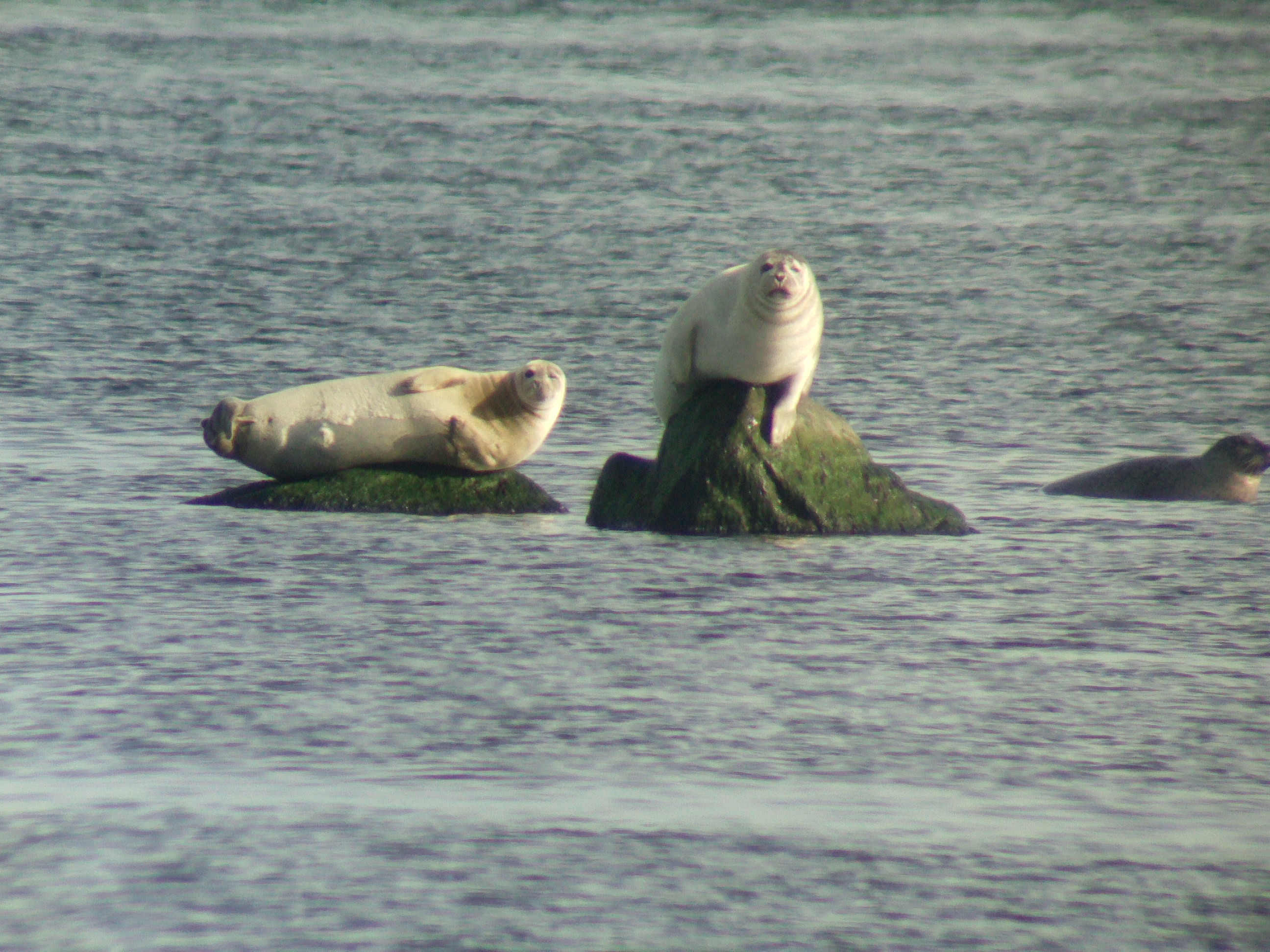
Around 10:30, all of the seals on the southerly rocks suddenly spooked; for a moment, I actually thought my coughing may have disturbed these seals under the unusually calm conditions. However, soon enough a single kayaker appeared out of the glare of the sun, and it was apparent that the seals saw the intruder before I did. The kayaker made a fine effort not to disturb the seals by paddling along the shoreline, but when it is this calm the seals are especially susceptible to being spooked by the low-riding, silent kayaks. The kayaker today was a good half mile away when the seals spooked, but by staying along the shore this conscientious paddler avoided scaring half of the seals, and eventually the other seals returned to the rocks to resume their rest.
When a good number of big seals are disturbed and subsequently decide to return to the rocks, this re-shuffling of the seal deck will usually trigger some territorial disputes, and the seals' behavior today was true to form. We watched for the next two hours as seals occasionally jostled to get the comfortable spots they wanted, with a good deal of associated vocalization clearly heard on the calm bay. At first it was the big seals on the flat rock that needed to get settled in; later, seals in the center cluster skirmished from time to time as late-arriving big seals continued to show up. This activity is always entertaining to observe, and a few lucky seal watchers got a nice seal show today around the noon hour.
At about 12:25, I noticed a small boat approaching from the south and shortly thereafter, a single kayak appeared coming out of the cove. The seals noticed the boat first and the sound of the boat occupant's voices distracted the seals' attention as the kayak drew closer. After the boat passed the rocks, the big seals on the flat rock immediately took notice of the approaching kayak and picked up their heads on high alert. Within about 15 seconds, all of the seals fled to the water, splashing noisily as they entered the water in a manner such that the kayaker had to know that she spooked the seals. The kayaker continued on beyond the rocks as curious seals checked her out from the safety of the water and remained in the area sufficiently long to put an end to the seals' rest for the afternoon. We keep detailed notes on the seal disturbances we witness, and this particular kayaker has done this on several previous occasions, being either totally oblivious, or perhaps not caring about how her actions affect both the seals and the seal seekers whose chance to see the seals has been spoiled. The next time we see this kayaker in the area, we are going to have to have a chat with her, as repeatedly disturbing the seals is something we will not tolerate on a continuing basis.
1-2-2016 8 seals hauled out, 45 degrees, WNW 10, clear, 16:15
We knew the seal watch was going to be short and late in the day, but we hiked out to Rome Point anyway for a little exercise and fresh air. The seals were moving in to haul out when a pair of kayakers appeared and paddled directly out to the rocks, spooking all of the seals... except one. This large seal, who was the first one to haul out, was facing away from the kayakers and seemed unfazed by the intruders. The kayakers stayed for about 10 minutes but after they departed a few seals slowly returned to the rocks. When the seals are disturbed while they are hauling out, it seems to affect the haul-out behavior of the entire seal herd and fewer seals take their rest on the rocks until the next low tide.
1-1-2016 52 seals hauled out, 42 degrees, WNW 10-15, clear, 16:15
Low tide has progressed to late in the afternoon, leaving just enough time for an hour of good seal watching late in the day. And good seal watching it was, as we got to watch the frolicking seals haul out in the evening sun. A steady procession of seal seeking families joined us for our brief seal watch on the first day of the new year, and one group got a good look a seal that porpoised repeatedly relatively close to shore. The only juvenile seal in the herd has been hauling out alone on one of the tall rocks, giving everyone good profile views of a seal on a precarious perch.
12-31-2015 48 seals hauled out, 45 degrees, NW 10, partly cloudy, 15:45
With low tide at 5:00 pm a late afternoon seal watch was the order of the day for the last day of 2015. It turned out to be a most worthwhile seal hike, as we watched the seals haul out, which is always more interesting than observing sleeping seals. When we arrived at 2:15, there were only 4 seals on the rocks, so we got to watch as the rest of the seals herd arrived. Today the seals were much more active than they were yesterday, with at least four individual seals jumping gleefully and repeatedly to announce their arrival. The northwest wind made for splashy conditions on the exposed rocks, so it took a while for the seals to settle. This was in stark contrast to yesterday, when the tired seals took up positions on still submerged rocks under relatively calm conditions.
12-30-2015 40 seals hauled out, 35 degrees, NNE 5 to 10, cloudy, 15:00
The seals appeared a bit weather weary this afternoon, as they took up their stations on still submerged rocks early in the ebb tide. Arriving seals quickly settled into sleep mode, indicating that they were tired from several days of swimming without a rest on the rocks. When the seals are worn out, there is little interesting behavior to observe, but we still had a nice seal watch, which was more brief than usual due to the chilly northeast wind.
12-26-2015 0 seals hauled out, 55 degrees, NE 10, partly cloudy, 10:00
We received a lump of coal in our seal watching stocking today in the form of a frontal passage and northeast wind, which combined to discourage the seals from hauling out. NE wind is always a 50/50 proposition, and it was unfortunate that the weather did not cooperate today, as the parking area was filled with seal seekers and dog walkers alike. So it goes with the natural world, where the creatures movements are attuned to the rhythms of nature in ways that we oblivious humans are often unable to fathom.
12-25-2015 45 seals hauled out, 65 degrees, S 10 to calm, partly cloudy, 10:00
We enjoyed a festive and merry seal watch this afternoon, thanks in large part to the many seal seeking families who took advantage of the warm weather for their holiday seal hike. Early afternoon was outstanding for seal observation with good light for the scope and cooperative seals well posed for all to see. A couple of seals put on an extended display of vocal and aggressive territorial behavior for the entertainment of an appreciative group of seal watchers on the shore.
However, at 1:50 our seal watch got Grinched by a couple of overly-exuberant dogs romping in the water, as the splashing and barking of the happy hounds attracted the seals' attention in the calm conditions sufficiently to scare the seals off the rocks. I was distracted assisting another visitor with the scope when the dog disturbance took place, and by the time I remarked that the dogs should be controlled it was too late and the seals were already on the move. It was unfortunate that the seals were spooked, as that put an end to the best seal watching of the day, but a small group of seals returned to the rocks to extend the seal watching into the late afternoon.
12-6-2015 31 seals hauled out, 45 degrees, SW 5-10, clear, 10:00
Today was an absolutely beautiful day for a hike at Rome Point, and we were joined on the beach by a steady procession of seal seekers; unfortunately, most of the visitors today arrived too late to see most of the seals. The nice weather also brought out other outdoors enthusiasts, including waterfowl hunters and kayakers, both of which are not conducive to good seal watching. We heard the gunshots as we hiked in and correctly surmised that the seals might be disturbed by the loud shotgun reports. When we arrived, most of the seals that remained hauled out were wet, indicating that they had returned to the rocks after being spooked by the hunters in Bissel Cove. The seals may tolerate nearby gunfire under some circumstances, but with the southwest wind carrying the sound of shots in their direction its likely that the seals decided the noise was too close for comfort.
The ducks in the area must also have figured out that the gunshots were too close for comfort, and departed for a quieter cove, as we heard no more shots. When the seals are disturbed right around the time they are hauling out many of them will leave the area, which accounts for the relative low number of seals on the rocks on this perfect late fall morning. For an hour we enjoyed close observation of about 30 seals, one of whom was behaving an an unusual fashion. A seal on the left side of the flat rock kept putting its right flipper to its mouth, and would follow this every time by arching its back so it was reared up almost vertically, and opening its mouth wide 3 or 4 times as if yawning. We have seen all of these behaviors many times before, but not in close conjunction in a sequence that was repeated at least 10 times while we watched. The seal was not really yawning, but that's just the best way to describe how it opened its mouth. Clearly, this seal was exhibiting some distress, and it did have a small fresh wound on its chest, but we have no clear idea of what the seal was doing or why it kept repeating this behavior.
At 10:15, a pair of kayakers passed by close to shore; while they did their best not to disturb the seals, the seals were already nervous from the gunshots and were in no mood to tolerate even distant kayakers, so all of the hauled out seals took to the water. This coincided with the arrival of a number of people on the seal watching beach, and for the next hour we watched a half dozen seals haul out and resume their rest. At 11:15 the kayakers returned on their return trip and once again the seals departed from the rocks, putting an end to the seal observation for today. This morning was a good reminder that even when weather conditions are ideal, seal observation cannot be taken for granted, as some human intervention is always a possibility, especially on weekends when the weather is nice.
12-5-2015 81 seals hauled out, 45 degrees, NW 5-10, clear, 9:00
4 Seals on far rock for 85 seals total. A very interesting seal watch this morning, with lots of seals scattered about on all of the rocks to the south of the tall rocks. Some late-arriving large seals stirred up the settled seals and made our observation more interesting by inciting some loud protest vocalization as they move in on rocks that were already occupied. Most interesting were the two large seals on the slanted rock, who fought mildly over the available space twice before reaching an agreement to share the relatively small rock. We did see some seals that we recognized, but the bright morning sun tends to make observation conditions challenging due to glare and long shadows concealing the seals markings. On seal that was notable in his absence was the old stalwart Linebelly, who has not yet made an appearance this season. Another seal was on Linebelly's favorite pointy rock, causing us to wonder if we have seen the last of our old friend, who was looking a bit under the weather when we last spotted him in the spring.
11-29-2015 15 seals hauled-out; 42 degrees, NE 10-15, partly cloudy, 15:00
Our first seal walk in over a month was remarkable due to the curiously low number of seals hauled out well into the ebb tide. It seemed likely that the seals may have been disturbed before our arrival, but perhaps the northeast wind was a factor, as there should be a lot more seals hanging out at Rome Point by now. We did manage to see several seals hauling out and some casual interactions, but it was a chilly afternoon on the beach and we would not have lingered as long as we did if not for our young and enthusiastic seal watching accomplices. The Rome Point shoreline always has plenty of interesting surprises to hold the attention of children, so this family outing was a resounding success, even if the seal observation left a little to be desired.
We spotted one large seal with a net entanglement scar, and this animal made us wonder a bit about the effect that the new fishing or aquaculture operation in the area may be having on the seals' movements and behavior. We are not sure what is going on out beyond the rocks but there are sure a lot of new buoys afloat and a couple of radar reflectors as well. This activity should be far distant enough from the close in haul out rocks so the seals will remain undisturbed, but the far rock that we have noted in the past is close to the new gear. In time our observations will reveal the nature and effects of this new activity, so for now we are cautiously optimistic that seal watching at Rome Point will remain unaffected by commercial activity. We look forward to a time soon when we can resume seal watching on a regular basis, so we can get a better feel for what's going on with the seals.
10-17-2015 13 seals hauled-out; 60 degrees, W 10-15, partly cloudy, 15:30
Not many seals around today, and most of them were wet when we arrived, indicating they may have been spooked into the water before we showed up. That possibility seemed even more likely as we watched the seals get run off the rocks 3 times in a half hour by a couple of boats in succession. The first boat left for a while but when they returned for a second, closer look they spooked all but one big brave seal. Another boat put an end to our seal watch with a close, direct approach, but this is par for the course for an October weekend seal watch as there are still a good number of boats out enjoying the bay on weekends when the weather is suitable.
10-14-2015 27 seals hauled-out; 65 degrees, SW 10-15, clear, 14:30 First seal watch of Fall 2015 season.
A new moon and a week of gusty easterly winds made us curious whether the seal had returned, and we were not disappointed as we enjoyed a most pleasant walk on a splendid early Fall day. All the seals were large specimens and were scattered on the rocks on the south end of the haul-out area. We recognized some of the seals on the flat rock, and observed one seal with dalmatian-style markings that has a double net entanglement around its neck. There was an interesting odor of rotting organic matter all along the shoreline today; we never noticed this smell before and were curious why it would be so widespread.
We also noticed a good number of fishing pots in the area around the rocks, and a couple of more worrisome fish traps set off to the Northeast. The seals do not generally approach the rocks from that direction, but the "far rock" that was sometimes refer to here is close to these fish traps. We expect that as the fishing season ends these fish traps will be removed, but we will be watching to see any signs that the fish traps are affecting the seals behavior, or if any seals become entangled in the stationery netting.
12-21-2017 56 seals hauled out, 36 degrees, NNW 5 to 10, clear, 15:00
2 seals on far rock for 58 seals total. At last, we got to enjoy a most pleasant seal hike this afternoon, as the seals were undisturbed for the first time this season. It was all good today with well-posed seals in good light, a smattering of active behavior, including porpoising and vocalization, and a sighting of Rome Point stalwart seal Linebelly to add an exclamation point to the end of our seal observation. This afternoon was made all the more pleasant by the contrast to our recent unsuccessful seal walks, indeed, absence does make the heart grow fonder.
We also enjoyed spending time with Katy and her companion from Vermont, who showed considerable interest in the seals as well as noteworthy observational skill. It turns out that Katy learned her water watchful ways in search of Champ, the legendary Water Horse of Lake Champlain. She has had several sightings and soundings (using hydrophones, which she had with her) of the elusive lake monster, and has posted some video and audio evidence on the website Champ Search as well as a number of interesting first-hand accounts of Champ sightings. We fondly hope that some day our new friend Katy is rewarded for her years of effort by obtaining indisputable video evidence of the existence of Champ; she has certainly come close, and is as personable and sincere of a human ambassador for Champ as the famous creature could have. We have held an interest in fabled creatures such as the Yeti, Saskwatch, Nessie, and Champ (as well as the proven living fossil the coelacanth) since childhood, and would be very gratified to have the existence of one of these animals proven beyond all doubt.
First Seal Observation for Winter 2017/2018
12-16-2017 26 seals hauled out, 24 degrees, WNW 15 to 20, clear, fresh snow 10:30
Seal watching peaked too soon today, as the sound of the shotguns of late autumn duck hunters were too much for the seals to tolerate. There were seals in sight the entire time we were there, but most of the seals flushed after a big shotgun volley shortly after our arrival, and only a few returned to rest on the rocks. We have not even bothered to record our first four seal observations this fall on the website, because on all prior recent visits, the seals were not on the rocks due to the presence of watercraft in the area. This marks our 18th year of seal watching at Rome Point and it has certainly been the most disappointing start of the season we have ever experienced, as the moderate weather in November and December allowed for an extended boating season. Still, we know thateventually winter will serve to keep most boats and kayaks off the water, to the benefit of the resting seals and eager seal seekers alike.
Last Seal Observation for Spring 2017
4-15-2017 22 seals hauled out, 58 degrees, SSW 15 to 30+ clear, 16:00
High winds this afternoon were responsible for the low seal count, even though a southwest wind is usually a favorable wind direction. Once the wind velocity gets up around 30 knots, its too windy for good seal watching, but we enjoyed a pleasant visit on the beach with a good number of other seal observers. When we first arrived we were entertained by watching the seals on the center cluster trying to get settled in the face of periodic larger waves that would wash over the rock... and wash the seals back into the water. These seals would then gamely haul out again, only to be lambasted again by another set of large waves a few minutes later. Finally, the tide receded sufficiently such that the cluster rock was above the wind-driven wave fray, allowing the seals to rest undisturbed as a reward for their persistence.
4-9-2017 115 seals hauled out, 55 degrees, W 5 to 15 clear, 11:00
6 seals on far rock for 121 seals total. Outstanding seal watching early in the tide until a couple of kayaks showed up at 11:05, with plenty of extremely vocal and aggressive seal behavior on display. The kayakers seemed oblivious to the seals and did not approach the rocks, but they flushed most of the hauled out seals into the water. A lot of seals returned to the haul out rocks and remained well posed for the many seal seekers who came out to Rome Point today to admire.
4-8-2017 176 seals hauled out, 52 degrees, NW 10 to 15 partly cloudy, 12:30
7 seals on far rock for 183 seals total. A great Spring seal watch with a large number of hauled-out seals resting placidly on the rocks and excellent lighting for close-up viewing through the scope. It was a somewhat distracted seal watch for us, as we entertained a good number of visitors and a canine companion while trying to keep tabs on the seals. We arrived too late to see the seals in action as they hauled out, and the herd was mostly asleep by the time we got there at low tide. We did get to see examples of most typical seal behaviors, and as the tide came in, there were several ferocious seal fights as the seals crowded into each other's personal spaces in an effort to stay high and dry. The best match was between a seal my granddaughter named Specklebelly and an intruder who encroached on Speck's favorite rock. These two seals snapped fiercely at each other, delivering bites to the neck and chest until they took their quarrel into the water to settle matters. We were amused to see Specklebelly clambering back up onto the rock after about ten minutes, suggesting the it took these two combatants a while to settle their quarrel before Specklebelly emerged victorious. Big red on cluster. Lucy, Audubon group, and horses.
4-2-2017 45 seals hauled out, 40 degrees, NW 15 before we arrived, then S 10 to 15, to NW 5 to 15 partly cloudy, 17:00
A very unusual seal watch, with some unexpected weird weather that affected the seals and the seal observation. When we left home the wind was out of the NW at a steady 15, but by the time we arrived at the Rome Point shore, the wind had strangely shifted to the south. Not surprisingly, the seals were not impressed with this development occurring right at their haul-out time, and there were few seals hauled out as the west wind served to hold the neap tide up in the bay. There were a good number of people around, so we hung around as well and were astonished when the wind pulled another 180 degree wind shift back to the NW. We are almost up to 800 seal observations, but we have no prior records of a strong wind switching so quickly in two directions. After the wind shifted back to the NW, the two southern-most rocks filled up with big seals, so there were some seals well positioned for viewing late in the afternoon, but for us, this day was memorable mostly for the wacky weather and the way the seals behaved as the wind it changed and shifted.
3-30-2017 148 seals hauled out, 40 degrees, NE 5 to 15, clear, 14:30
6 Seals or far rock and 3 at Greene Point for 157 seals total. Outstanding seal watching today, with numerous active seals in the area and excellent light for telescopic observation. The easterly wind was similar to our last seal watch in that it was cool, but not sufficiently harsh so as to make our time in the beach uncomfortable. There were about 70 seals on the rocks when we arrived, and we watched as the seal count doubled and numerous seals displayed active behavior, either territorial procurement or just being happy jumping frolicking seals. One seal jumped repeatedly 8 consecutive times, and a half-dozen other seals performed lesser, but still impressive, aerial displays. The taller rocks were covered with large seals, and some of these animals moved to lower haul out locations as the astronomical low tide receded. This resulted in a continuous re-shuffling of the seals' locations, with the associated vocalization and confrontational behavior providing for an truly action-packed seal watch. Almost all of the lower rocks were battlefields at one time or another, and the aggressive behavior seemed particularly violent and prolonged today, with one skirmish on the right mound actually drawing blood from a ferocious bite on the neck.
We spotted Big Red the resident Grey seal on the tall rock again today, and when the big fella made his move to the already jam packed cluster, this caused a veritable seal riot on the cluster. Some big harbor seals on the front of the cluster were able to fend off Big Red at first, and the Bid Red signaled his displeasure with the haunting siren song of the Grey seal. The larger Grey seal was not to be denied, and continued probing different locations on the back of the cluster until he was finally able to locate a less ably defended access point. As Big Red muscled his way into position, about 10 harbor seals were forced to move over, which caused them to fight among themselves for a good 15 minutes until all the remaining seals were re-settled comfortably.
Additional comments on this seal watch to be posted later.
3-25-2017 98 seals hauled out, 45 degrees, NE 5 to 15, cloudy, 11:00
6 Seals on far rock for 104 seals total. Very good seal watching today for the first time in a long time, as the easterly wind, while chilly, was not strong enough to be too uncomfortable for the seals or the seal watchers. The numerous seals present were well posed for telescopic viewing with excellent light for the scope, so the many families who joined us on the Rome Point shore today enjoyed clear views of fairly active seals. The best morning activity took place when Big Red the Grey seal made a move from the top of one of the tall rocks to the center cluster of harbor seals. The smaller harbor seals were powerless to prevent the Grey seal from resting anywhere it wished, but the disruption cause by Big Red moving in led to a major skirmish among the displaced harbor seals as they fought among themselves to establish comfortable new resting territories.
A pair of kayakers passing through the area at 11:05 flushed about 2/3 of the seal herd; however, the paddlers did not approach the rocks and many of the seals returned and took up new resting stations, which resulted in about 45 minutes of interesting active seal behavior. An hour after the kayaks passed by there were about 70 seals hauled out for our long-time seal watching friends Rhode Families in Nature to enjoy. This large contingent of families with mostly young children in tow make a Rome Point hike an annual event, and we were very pleased that the kayakers left the seals mostly undisturbed so Jeanine's group all had ample opportunities to see wild seals up close and personal through our spotting scopes. As the smiling kids and adults took their turns at the scopes, I could not help but contrast all the fun everyone was having to how the different and disappointing the situation would have been had less knowledgeable, discourteous kayakers been in the vicinity today. If the kayakers had paddled out to the rocks and approached the seals, they would have spoiled the seal show for everyone, but instead, because they knew what they were doing, the self-aware, skilled kayakers we observed got to enjoy their chosen pastime without ruining today's seal watch for all of the friendly families who enjoyed a great seal hike today.
3-12-2017 0 seals hauled out, 42 degrees, WNW 15 to 20, clear, 11:00
The most disappointing seal hike of the season so far, with no seals on the rocks and only a couple of swimmers spotted in the half-hour we spent at Rome Point. Conditions were perfect for a big seal turn out as far as we could tell, but there were just no seals around for reasons that remain a mystery to us. Perhaps the seals were run off the rocks by watercraft before we arrived, but we were there two full hours before low tide and usually, at least a few seals will haul out while the tide is still running out, even if most of the herd has been spooked hard by boats or kayaks that approach the rocks and remain in the area. The swimming seals that approached the rocks behaved in a manner similar to how they act when the wind is unfavorable or a front is passing through the area, but on this day the weather conditions were almost ideal. Today was one of the most puzzling (no) seal observations we have had in over 15 years at Rome Point, so we suspect human activity may have disturbed the seals before our arrival this morning.
3-9-2017 75? seals hauled out, 52 degrees, W 20 to 30+, clear, 10:15
Our seal watch today was unusual in that it was blowing a gale on the bay and we were accompanied by a polite group of environmental studies students from Blackstone Academy charter school. Because of the large group that was present, we did not do our usual detailed seal count, but it was clear that the big wind reduced the number of seals on the rocks and made the seals that were there somewhat unsettled. The seal watchers were as interesting to observe as the seals today and with a big group of teenagers it was fascinating to watch how the different groups of kids showed different levels of interest and a variety of behaviors much more variable than the seals. Some of the kids that "got it" and focused on the wildlife observation had good opportunities to see some interesting seals and marine mammal behavior, while for others the outing was little more than a pleasant hike on the beach. I found a large, partly broken channeled whelk shell, with the animal still inside, to show the group and the omnipresent Asian shore crabs never fail to entertain, but for the most part the level of interest was somewhat lacking. However, this was all the better for the kids like Liz, Hugo, Shawn, and a few others whose names I did not catch, as those who wanted to were able to enjoy a fairly good seal watch considering the windy conditions.
I was fairly distracted most of the time, but I did manage to spot my old seal friend "Big Red" the Grey seal for the first time this year among the harbor seals on the cluster. Other seals such as Linebelly and the seal with the fresh net entanglement were also on the rocks, but viewing conditions were only fair at best, and the prime rocks to the south were unoccupied due to excessive splashy wave action. At about 10:30, a good number of the seals left the rocks, and we departed shortly thereafter. On the way back to the parking lot, I pointed out the croaking calls of the woods frogs, a harbinger of Spring which I was hearing for the first time in 2017. I remarked that they better get their croaking in today, as with late-winter snow in the forecast, it may be a while before the calls of amorous amphibians are heard again at Rome Point.
2-26-2017 86 seals hauled out, 44 degrees, SW5 to S 10+, clear, 13:00
We enjoyed fairly good seal observation today, with a good number of people around to share in the Sunday seal watching fun. Our notes from this seal watch are sketchy, but many of the same seals we have been seeing the past five days were perched on their customary rocks, with the taller rocks being unoccupied. The light for the scope was considerably better that it has been lately, which allowed for more clearly focused close-up views of the seals, and we stayed much longer than we intended, having to drive to Bangor, Maine when our seal watch was concluded today.
2-24-2017 107 seals hauled out, 58 degrees, SW5 to S 10+, clear, 10:45
6 seals on far rock for 113 seals total. Today's seal watch was a carbon-copy of yesterday, which is to say there were lots of interesting seals, and crummy lighting conditions for telescopic observation. Even the seal's sudden departure at 1:25 was identical to their behavior yesterday. When the south wind picks up to around 15 knots on the flood tide, the seals will often depart all at the same time rather hastily, and this happened again today. All of a sudden, about 80 seals took to the water with almost no advance indication they were going to leave, and all of these seals immediately vacated the premises with nary a glance back at the rocks as the herd headed towards the ocean.
2-23-2017 102 seals hauled out, 54 degrees, SW5 to S 10+, clear, 10:00
6 seals on far rock for 108 seals total. Very good seal watching this morning, that was only prevented from being outstanding by the poor light conditions for telescopic observation. When the spring sun is bright and humidity is high, optical distortion is magnified along with the seals' image, which degrades the clarity of the image and limits the amount of magnification we can dial up on our spotting scope. This is of little concern to casual observers, but we have become rather particular for our own seal observation purposes, and much prefer the crystal clear views we get of the seals on cloudy or less humid days.
That said, the numerous seal seeking families that we met today were perfectly happy to see nearly 100 seals on the rocks through the scope. The warm conditions on the sheltered shoreline allowed people to linger on the beach comfortably, and several groups took several turns at the scope. The seals were especially well-settled and most slept soundly for a long time with very little activity. However, as the tide came in the seals started to move a bit, and we watched with interest as a couple of seals got into a bit of a dust up over a particular haul-out rock. Upon closer examination we were very pleased to see that one of the seals was the seal that my granddaughter named Specklebelly last spring, and that Specklebelly, with his distinctive spot pattern, was back on the very same rock where I photographed him in 2016.
By 1:00 pm the wind was pushing the rising tide well up onto the rocks and the seals departed hastily. This was unfortunate for the many hopeful afternoon seal watchers who had filled the parking lot to overflowing on this spring-like day. The RI DEM sponsored a hike today starting at 1:00 pm, and upon learning about this walk last week we contacted the DEM parks department and suggested that 1:00 was a little late in the flood tide to expect to see many seals on the rocks. Unsurprisingly, we were not afforded the courtesy of a response and sure enough, anyone accompanying the DEM on their hike was no doubt disappointed that there were no seals to be seen. We have had repeated dealings with RI DEM on both a professional and recreational basis over the past 20 years, and in all cases, save a few interactions with research teams, we have found representatives of this agency to be sorely lacking in both competence and productivity. Rhode Island has many natural wonders and faces environmental challenges on numerous fronts, and we are continuously dismayed to see that the state agency primarily responsible for protecting the ocean state's natural resources is poorly managed, under-funded, and can barely muster even a lame effort in a number circumstances that we have personally observed or have firsthand knowledge about.
2-22-2017 60+ seals hauled out, 50 degrees, W5 to calm to S 10, hazy to clear, 10:00
We did not get a good seal count today because the seals were flushed from the rocks by kayakers before we arrived on the beach. We watched in dismay from afar as all of the seals, except for a single brave stalwart, were run off the rocks by kayakers on what would have otherwise been a perfect day for seal observation. However, the weather was so nice that about 8 seals returned to the rocks after the kayaks departed, and additional seals gradually came back over the next 1 1/2 hours. When Linebelly returned to the pointy rock and another seal hauled out on the slanted rock, we had a couple of seals at least that were well posed for viewing; later, seals on the right mound and flat rock provided additional good looks at a few seals. We even got to observe one brief flurry of activity in the water as one small seal porpoised 3 times in quick succession. All in all, this seal watch turned out much better than we would have supposed, which saved the day for a few seal seekers who joined us on the beach before the building south wind dispersed the seals just before 1:00pm.
2-21-2017 63 seals hauled out, 43 degrees, N5 to calm to S 15, clear, 10:15
5 seals on far rock for 68 seals total. A very pleasant morning seal watch, but a bit solitary for our taste, considering it's winter school vacation week. Still, the seals obliged us with excellent views all morning and one new friend chose an excellent morning to enjoy a lengthy, and hopefully informative, seal watch with us. At 11:10, all but about 10 seals spooked for no apparent reason, which was somewhat unusual as the large mature seals were the first to show signs of anxiety and take to the water. Usually the stalwart seals on the far right flat rock are the last to be fooled onto thinking that a non-existent threat is approaching, but today, they led the herd off the rocks and into the safety of the water. The seals spy hopped about looking in all directions, and when no intruders were spotted about 35 seals returned to the rocks, which is always interesting to observe.
We had to leave around 11:30, but we rounded up one family to show them the seals before we left, and the children were pleased to get close-up looks at the seals. One seal that has a net entanglement around its neck hauled out in profile on the slanted rock, which I showed the kids while explaining how this seal got its necklace. The last little girl to look enjoyed an exceptional observation as she exclaimed, "he's pushing him". Sure enough, the seal that was previously on the slanted rock before the herd flushed had returned, intent upon reclaiming his desired perch. The seal with the net necklace put up a game defense of his position, which made for exciting action until the larger seal finally dispatched him off the rock with a big splash, and clambered up to take his rest. The little girl was most amused by this sight, and was grinning broadly as she left the scope to play with the other children, in the manner of the cat that got the seal watching canary as a reward for her patience in taking her turn at the scope.
2-17-2017 47 seals hauled out, 38 degrees, WNW 10, clear, 15:45
We had a little time in the late afternoon for a quick seal scouting mission and trail condition check, both of which were successful. As we expected the seals were out enjoying the late day sunshine, and, also as expected, some sections of the trail were icy and very slippery. We just did a quick seal survey through binoculars, which revealed the striking, copper-colored seal we observed a couple of weeks ago hauling out on Linebelly's favorite pointy rock, while Linebelly was laying on the adjacent flat rock that he has lately shown some affinity for.
2-11-2017 10 seals hauled out, 38 degrees, N 5 to N 15, cloudy, 13:30
5 seals on far rock for 15 seals total. The seal count was surprisingly low today, for reasons that took a while to become apparent to us. At first we thought the seals had been spooked before we arrived by watercraft in the area, but as the wind picked up we noticed it was directly out of the north, not the predicted west wind that the seals greatly prefer. When we checked our Windfinder app, we saw that the wind had suddenly shifted from south to north about an hour and a half before we arrived, signaling the passage of a cold front through the area. When a frontal passage coincides with the seals' haul-out time, the seals are able to sense this and it affects their behavior; in this case, many seals chose to remain in the water today.
2-8-2017 81 seals hauled out, 58 degrees, SW 5 to 10 to NW 15, hazy, 14:30
1 seal at Greene Point and 5 on far rock for 87 seals total. We could not resist the temptation to enjoy this spring-like day on the Rome Point shore, especially in light of tomorrow's forecast for a foot of snow. We were rewarded with the most seals we have seen this winter, however, the hazy, humid conditions were less than optimum for telescopic observation. Still, the seal watching was well worth the time invested, with somewhat active, and quite talkative seals on every rock for us to see. Linebelly was back on his long-time favorite pointy rock, and he, as well as many other seals, extended their rest cycle as long as they could into the incoming tide. The seals had to contend with a blustery day yesterday which was likely not conducive to good rest, and with blizzard conditions on tap for tomorrow, its was almost as though the seals had looked at the same weather forecast as I had, and were resting up today to ride out the coming snow storm.
1-29-2017 64 seals hauled out, 40 degrees, W 15+ to 10, partly cloudy, 14:30
1 seal at Greene Point and 2 on far rock for 67 seals total. The seal were much earlier to arrive than they were yesterday and most of the rocks were well populated when we arrived at noon. A fair number of seals took up stations on the same rocks that they occupied yesterday, including Linebelly and the seal with the double neck entanglement scar that will from now on be referred to as Ringneck. As is occasionally the case, on this day several groups of visitors declined our offer to get a good look at the seals through the scope at first; the amateur sociologist in us always wonders what it is about certain days or circumstances that causes people to be a bit standoffish in this most non-threatening social situation. Once one family takes a look through the scope and begins to relate to me and to each other talking about the amazing up-close views of wild harbor seals, and others see this interaction, then everyone else wants to look at the seals too. However, when it is just myself standing there, as is the often the case when I first arrive, occasionally some people do decline my invitation to view the seals through the scope; this happened twice today right off the bat. I always try not to "hijack" anyone's experience on the beach and rarely invite people to use the scope until they are getting ready to leave, as I have been taught to do by my professional naturalist mentors, so it's not as though I am aggressive in any way. I am not put off by this in the least, I just find it interesting to note how people sometimes take their cues from the behavior of others even in the most casual, relaxed environment; while on most days, everyone is eager to see the seals, whether or not other seal watchers are present.
Once the seal watch got rolling, everyone enjoyed a fine Sunday afternoon watching the seals, including one very nice group of about six little girls whom we met seal watching last year. These kids showed no shyness or aloofness in using the scope and commenting on their observations, to the delight of everyone present. I could not help but wonder if the groups that declined my invitation to share the spotting scope earlier today would have responded differently if they had witnessed these happy, grateful kids at nature play. At 2:15 a fast-moving kayaker paddled through the area, flushing about 40 seals off the rocks, and leaving only those seals on the back clusters for us to observe. Several more families did get to see the seals, but the best of the seal watch was over and at 3:00 the kayaker returned and spooked the remaining seals, putting a premature end to what was nonetheless another in a string of recent good January seal observations.
1-28-2017 61 seals hauled out, 40 degrees, W 15+ to 10, cloudy, 14:00
1 seal st Greene Point for 62 seals total. The seal watch today got off to a slow start, as the seals were a bit tardy arriving considering the west wind/new moon circumstance, and we got to the beach just as the morning seal seekers were departing. We had the beach to ourselves as the pace of the seal arrivals quickened, and we enjoyed good observation as the seal hauled out. The highlight of the haul out was when our old buddy Linebelly showed up and found his new favorite flat rock already occupied. It took only seconds for Linebelly to decide that this challenge to his supremacy could not go unanswered, and and the big seal lunged from the water delivering a bite right to the face of his surprised opponent. Both seals took it outside to the water, where the battle was quickly decided in Linebelly's favor. As we watched this action unfold, we were not completely sure that Linebelly was actually the aggressor, but our initial suspicion was confirmed when he turned on his side and revealed his distinctive scar.
The rest of the seal watch was another fun and sociable weekend affair, with excellent light for close-up telescope observation and plenty of friendly company joining us on the beach. The low astronomical tide coupled with excellent viewing conditions kept us on the beach all afternoon, but late in the afternoon we were visited by a somewhat unusual guest. We heard an unusual high-pitched whine that we first attributed to distant dirt bikes, but when the sound persisted it became apparent that the odd noise was not motorcycles. When we finally looked up we spotted a quad-drone hovering directly above us high in the air. Our previous encounters with drones at Rome Point have resulted in the seals being flushed by the approaching drone, but today the drone's operator was satisfied to keep his distance, leaving the seals undisturbed. We have been contacted by a couple of drone hobbyists this season who have been considerate enough to inquire whether they might be able to check out the seals with their quad-copters, and we provided them with our recommendations. It pleases us to see that there are at least some... and hopefully many drone owners who are responsible stewards of their hobby and who realize that harassing wildlife with their aircraft might not be the best way to make friends or to cast their chosen avocation in a positive light.
1-22-2017 34 seals hauled out, 44 degrees, NE 5 to calm to N10 10, cloudy and hazy, 9:30
4 seals on far rock for 38 seals total. A hazy early morning seal watch under calm, neap tide conditions took an unexpected turn when a boat with a couple of waterfowl hunters on board made a sudden appearance at 9:45, spooking all of the seals from the rocks. The boat did not stay in the area, but we were not surprised that only a few seals returned to the rocks, as it was past low tide and the seals had already taken their rest. We were snapping the covers closed on the scope preparing for an early departure from the beach, when we spotted a little girl and her adult escort coming around the corner. We decided to hang around to show the seals to this intrepid duo, and as it turned out, this was a fortunate decision.
The bold little girl raced ahead of her more cautious grandmother across the rocky shore, and proceeded to plop down on a rock right beside us, in a manner that suggested this was not her first seal rodeo. When her Grammy arrived, I was introduced to young Ezri, who as it turned out, did indeed remember me from a previous trip to Rome Point, and we enjoyed her astute commentary as she surveyed the seals through the scope. She and her companion stayed around for awhile as they awaited the arrival of her father, and we continued to be entertained by Ezri's insightful questions, which gave us an opportunity to pontificate in some detail about seal and shark behavior to a steady stream of arriving seal enthusiasts. On a day when the seal show was rather run-of-the-mill for us, it was immensely pleasing for us to see how one special little girl was the catalyst for such a friendly, entertaining seal watch for everyone.
Conditions on the bay were calm for most of the morning, and as the stream of visitors slowed down during the usual lunch hour lull, we took the opportunity to get some photos illustrating examples of seal behavior on a calm day with a lazy tide. The seal pictured below gives the illusion of floating, but is actually resting on a submerged rock. With the slow current and no waves, this seal was able to maintain this position for an extended time as the tide came in...
As did this seal as well, which struck the often-seen" banana" pose to a yoga-ish extreme and held this partially submerged position for a long time, as if it had attained the mindful relaxation of a yoga master.
1-16-2017 41 seals hauled out, 38 degrees, SW 15 to 10, clear, 14:00
Another fine January seal day, with a continuation of comfortable weather and a mellow, well lit seal show to keep the many families in attendance amazed and amused. One seal that has amused us often over the past 10 years is the inimitable Linebelly, who has shown less of an affinity for his customary pointy rock perch this season. Perhaps in his old age and ever increasing girth he has decided that a more comfortable resting rock is more suitable, as we have spotted him on this flat rock adjacent to the pointy rock on several occasions recently.
Another regular source of amusement at Rome Point are some of the dogs that accompany their owners on their hike. Today we were entertained by the presence of Roman, a king-sized 150 lb great dane. His calm and friendly disposition was most charming and he exhibited exceptional patience as his owner and her friends checked out the seals. I had just remarked on what a good seal watcher Roman was when a small dog appeared on the bank behind us, sending Roman into a brief but impressive frenzy of amazing vertical jumping, as his owner wrestled to restrain the leaping beast. The jumping height this dog could attain from a standing start was astonishing, and his owner told me she calls him kanga-Ro in recognition of his leaping prowess. Once again an afternoon at Rome Point showed us that you never know what you might see on a seal hike, and that the activity on the shore sometimes rivals the seals for entertainment value.
1-15-2017 43 seals hauled out, 36 degrees, NNW 15 to 10, clear, 14:00
5 seals on far rock for 48 seals total. A fine weekend seal watch today, with a good number of seals around and good-as-it-gets optical conditions for up close views of the seals through the scope. We arrived early enough to watch the seal herd populate the rocks, with a good amount of the behavior associated with seals hauling out on a nice winter day. For some reason known only to the seals, the usually favored flat rock remained unoccupied all afternoon, but other rocks were taken by seals well-posed for many first-time Rome Point visitors to admire. One seal that is getting a lot of attention is the seal shown below with the striking copper-colored coat.
At about 14:00, we noticed the seals higher up on the ridge rock turning around to leave their perch, so we scanned the bay, expecting to see a boat or kayak approaching the rocks. We were surprised to see no watercraft in the area, and even more surprising was the speed with which the entire seal herd took to the water. The seals were clearly frightened more than usual, as they moved far from the rocks quickly without surfacing and only came up to survey the situation when they were a good quarter-mile out in the bay. We see the seals flush from time to time for no apparent reason, but I can't recall any time when they fled so far, so fast, and with such fear without good cause. For about 15 minutes no seals came back and we were afraid our seal watch was over for today, but eventually some seals slowly returned to the rocks, much to the delight of the many seal watching families who were out for a Sunday seal hike. Over the next hour and half, we shared a delightful seal watch with numerous seal watching friends old and new joining us on the beach for a great views of about 23 wild harbor seals.
1-14-2017 23 seals hauled out, 30 degrees, SSE 15 to 5+, cloudy, 15:00
5 seals on far rock for 28 seals total. Unusual weather led to an unusual but interesting seal watch today, as the passage of a warm front through the area right at the time when the seals should have been hauling out affected the seals' behavior. It has taken many seal observations for us to discover the various ways the seals respond to a sudden change in the weather and wind, as this does not often happen at precisely the right time to have an obvious effect on the seals. Today, it was immediately clear that the seals were very unsettled and relatively scarce well past their usual haul-out time, as seals came and went from the rocks in a fashion contrary to their usual hauling out behavior. One minute there would be a dozen seals hauled out, then a minute later, most of the seals would be back in the water. This continued on and off until about 14:00, when about a dozen large seals arrived and settled relatively quickly on the south rocks. By this time the rocks were well out of the water, so we were treated to the sight of some big seals clambering awkwardly up the rocks, as well as one lengthy territorial dispute involving 4 seals all interested in a favorite low-lying rock. The visiting seal hiking families were mostly late arriving today, as were the seals, and we enjoyed a sociable and entertaining seal watch in the late afternoon.
1-12-2017 64 seals hauled out, 54 degrees, SW 15 to 20+, clear, 14:00
3 seals on far rock for 66 seals total. We could not resist a quick seal hike today, as we found temperatures in the mid-fifties too enticing to resist on a January day. We were late for the tide and the light was not too good, so the seal watching was rather unremarkable, but as always the natural world worked its soothing magic on a heart that is aching from a recent family tragedy. Today was more about a reflective, pensive walk in the woods than it was about seal observation, and we were not surprised that once again a hike to see the seals suited us to a tee, circumstances notwithstanding. We were pleased to see there were a good number of seals around, which was good enough in itself for this day as we look forward to the upcoming MLK day holiday weekend seal watching.
1-2-2017 72 seals hauled out, 44 degrees, NW 15 to 20+, clear, 15:30
The best seal watch so far this season, with active seals, plenty of seal watching company, and even a skilled, considerate kayaker who did his best to avoid spooking the seal herd. There was a lot of action in the water as the seals arrived, with a half dozen different seals taking to the air in a variety of gleeful jumping exhibitions. The flat rock on the right was filling up with the usual suspects when a big Grey seal suddenly hauled his 600 pound self onto the rock, sending the smaller adult harbor seals fleeing back into the water. It was a treat to see the first Grey seal of the season, but the big fellow perhaps felt offended by the harbor seals that shunned him as he quickly returned to the water and did not haul out again.
From time to time we observe seals with "necklace" scars from net entanglements; sometimes, the netting is still present wrapped around the seal's neck or torso. We can identify some seals that have this characteristic wound, and there is a seal with a distinctive double necklace scar that we have been seeing regularly for the past three years. The seal shown below is one we saw for the first time today; it appears that this animal has been wearing its "necklace" for a long time, but seems to be an otherwise perfectly healthy animal..
1-1-2017 No seals hauled out, 35 degrees, NW 15 to 20+, clear, 12:45
Some exceptionally stupid and reckless kayakers, who did not possess either the equipment or skill to be out on the bay in the winter wind (and who have flushed the seals on other occasions), chased all of the seals away 3 hours before low tide this afternoon. We have little quarrel with well-equipped, skilled winter water sports enthusiasts who may inadvertently flush the seals from time to time, but today's performance was quite disappointing, especially for the many seal seeking families who did not get to see the seals because of the foolish, inconsiderate behavior of the clueless kayakers we watched today. In six visits to Rome Point this season, we have seen the seals flushed on four occasions, and we are not going to trouble ourselves or visitors to this website with a running commentary on this subject anymore. In the future, our remarks will be brief when the seals are harassed and chased from their resting rocks, we have seen and commented on this troublesome, tiresome topic more than enough.
12-31-2016 70 seals hauled out, 38 degrees, SW 10 to SSW 15+, cloudy, 13:15
7 seals on far rock and 1 at Greene Point for 78 seals total. Very good seal observation today, with lots of seals and seal watchers, plus excellent optical conditions for close-up telescopic viewing. We were treated to our first Linebelly sighting right away, which had us exclaiming out loud with happiness at seeing our long-time favorite seal once again this season. This sighting marks the tenth season that we have spotted the venerable, honorary king of the Rome Point seals perched regally on his pointy rock throne.
Unfortunately, Linebelly's reign today was interrupted around 1:20 by intruding barbarians in the form of a boat out for a seal watching cruise. The boater did not approach the seals excessively closely, but a southerly wind tends to make for anxious seals, and about half of the seals in the center of the group flushed when the boat throttled down to take a look. This left us with 45 seals to check out for the rest of the afternoon, but the remaining seals were well-posed for observing through the scope; so much so that we barely missed Linebelly and the rest of the nervous seals that departed early this afternoon.
12-25-2016 58 seals hauled out, 34 degrees, W 10 to NW 15, clear, 12:00
A pleasant Christmas seal walk today, with warm sun making for comfortable conditions south of our usual observation location out of the brisk wind. We had limited time for seal observation with our Christmas schedule to attend to, so we had to leave before the afternoon seal watching rush hour, but we did get to share good views of settled resting seals basking on the rocks with several families. The most interesting observation of the day was on the pointy rock, where a smaller seal took up station on our old buddy Linebelly's favorite perch. The Rome Point old-timer was late to the party last season, so we remain hopeful that he will once again grace us with his presence in 2017. We have seen about 8 seals that we recognize from past years so far this season, but it is always a treat when we have our first Linebelly sighting of the year, as this seal has been hanging out at Rome Point for at least the past 9 years, and his regal perch upon the pointy rock has served to make him a favorite of many seal seekers over the years.
12-3-2016 25 seals hauled out, 45 degrees, NW 20 to 15, clear to partly cloudy, 15:30
An unusual and entertaining seal walk this afternoon, that got off to a slow start with only three seals hauled out under windy and splashy conditions. As the unsettled seals came and went, we noticed a large raft of ducks beyond the rocks, and when we zoomed in we saw by far the largest aggregation of red breasted mergansers that we have ever observed. The duck flock numbered over 200, all paddling north in about a half mile long line against the tide and the wind. When we turned our attention back to the few seals hauled out on the center cluster, we noticed that one seal had an unusual large, ragged wound on its back. When the seal turned sideways, we saw a series of four evenly spaced, two to four inch, vertical wounds on its posterior right flank. We can never be sure, but this looked just like the sort of wound that might result from narrowly escaping a shark attack, and we will be keeping an eye out for this seal, with its readily identifiable scars, in the future.
After about an hour, the wind abated somewhat, and more large seals began to haul out. The late arriving seals provided the best seal observation of the day for an enthusiastic group of URI coeds, who provided a sociable spark to the end of our seal watch today. The social media savvy young women snapped photos of seals through the scope with their phones, which no doubt were insta-grammed or posted in whatever manner is fashionable these days. The highlight of this activity was when one young lady was face-timing with her mom, and held her phone up to the scope so her mom could see the seals. We all heard her mom's excited exclamation as the seals came into view on her screen, which punctuated the first, but undoubtedly not the last, live-streamed seal pod cast from the shore of Rome Point.
11-26-2016 9 seals hauled out, 45 degrees, NE 10 to 20 cloudy, 11:30
6 seals on far rocks for 15 seals total. When we arrived at the beach 1/2 mile south of the seal watching site, the sight of a boat, 4 kayaks, and only a couple of seals at the haul out rocks had us muttering under our breath in disapproval. We decided to continue north up the beach anyway, which turned out to be a good idea, as a small group of seals returned to the rocks to pose nicely for the viewing pleasure of a the friendly visitors who joined us on the beach around noontime. One of the seals had a serious net entanglement problem with a yellow nylon rope clearly visible encircling the poor seal's neck so we will be keeping an eye on this large seal to see if it manages to survive it's unfortunate misadventure. Some seals live for years after a net entanglement with only a permanent necklace-like scar to show for their trouble, while other seals are surely not so fortunate; in most cases, we are unable to be sure of the fate of seals we have seen tangles up in rope or netting.
First Fall 2016 Seal Walk 11-25-2016 60 seals hauled out, 45 degrees, NE 10 to 15 cloudy to drizzle, 10:30
5 seals on far rocks for 65 seals total. We took a chance on the weather this morning and were rewarded with a brief but enjoyable first seal observation of the season. We were greeted with a round of welcoming vocalization, and had a good chance to get close up looks at all the seals in good light, allowing us to identify a half-dozen seals that we recognized from last Spring. As we chatted with a visiting family, the seals on the flat rock flushed, as they spotted a lone kayaker before we did. The paddler stayed close to shore and we were surprised when all of the seals took off; even more surprising was that only a few seals chose to return to the rocks. With a bit of uncomfortable drizzle in the air and most of the seals departing, we decided to call it a good short seal watch and headed for the parking lot sooner than we would have liked on a holiday Friday.
3-26-2016 145 seals hauled out, 40 degrees, NE 10 to 20, cloudy to clear, 15:00
5 seals on far rocks for 150 seals total. A very good seal watch today with great lighting conditions for the scope allowing us to zoom in closely to get great looks at the resting seals. While the seals and most seal watchers may prefer a sunny day, we are partial to cloudy days that provide the best optical conditions for telescopic observation. Days like today are especially good for identifying individual seals that we have noted before, and we quickly ascertained that Specklebelly was right back on the same rock as yesterday. We were able to spot another half-dozen seals that we recognized from observations in previous years, and now with some of our past photos archived on our smart phone, we have greatly upgraded our capacity for identifying individual seals. As the chilly northeast wind picked up, the conditions on the beach became uncomfortably cold, and we were almost relieved when most of the seals flushed at 3:55, putting an end to a fine Saturday seal watch.
3-25-2016 130 seals hauled out, 60 degrees, SW 10-15, cloudy, 15:00
6 seals on far rocks, 6 at Greene Point for 142 seals total. The seals were already settled when we arrived and we only had time for a brief observation on this Good Friday. I had my granddaughter along on our seal hike today, and we decided to pick out a distinctively-marked seal to see if we can identify this individual animal repeatedly in the years to come. We selected a smaller seal with a lot of dalmatian-like spots, and she chose the name "Specklebelly" for our newly named friend. The photo below shows Specklebelly perched in front of the Table rock, with a distinctive clump of spots visible that will serve to aid in the identification of this seal in the future.
3-23-2016 135 seals hauled out, 60 degrees, W 10 to calm to S 15, hazy to clear, 14:00
11 seals on far rocks, 9 at Greene Point for 155 seals total. Exceptional seal watching with active seals that put on several good seal shows over the course of the afternoon. A lot of seals spooked off the center area around 12:35, and this triggered an active period for 1/2 hours as the seals got re-settled. This activity exposed Big Red on the center rock and as surrounding seals jostled for comfortable positions the Grey seal regaled us with his musical vocalizations as he expressed his displeasure with his neighbors. At one point, a couple of harbor seals used Big Red for a pillow, and he let them, and us, know with his mournful cry that this was not acceptable.
After the wind picked up out of the south, the seals started leaving, culminating in a fairly rapid departure at 3:20, when the remaining 50 to 60 seals all took to the water at the same time. Something about a south wind makes the seals behave in an erratic manner, and the sudden, simultaneous departure we witnessed today was unusual behavior that we have seen only occasionally. However, when this happens it is almost always when the wind picks up sharply out of the south some time after low tide.
3-20-2016 101 seals hauled out, 40 degrees, NE 15 to 5, partly cloudy, 12:45
7 seals on far rock for 106 seals total. A challenging seal watch today with the chilly easterly wind, but still very good seal observation featuring especially good light for viewing the seals close-up through the scope. When we first arrived, the inescapable cold wind was sufficiently uncomfortable to make us think that this would be a brief seal observation session, but as more seals arrived with associated interesting behavior and a steady stream of seal watchers came and went to keep us company, we powered through the chill and stayed on the beach most of the afternoon. All of the entertaining behaviors we see when there are a lot of seals in the area were displayed at one time or another, and the seal herd was less settled that they had been the two previous days. We happened to be watching closely at 12:55 when the seals started to scan excitedly and assumed more alert postures, indicating that they were about to flush into the water. Whatever the imagined they saw was not apparent to us, nonetheless, about 70 seals took a swim as the contagion of nervous excitement overcame the herd. Most of the seals were quick to return to the rocks, and the previously unoccupied flat rock was covered with large seals as the group settled in for an extended nap. As the cold wind died down, we settled in as well for an extended seal watch that lasted much longer this afternoon than we would have expected, given the harsh conditions when we set up at 11:00.
3-19-2016 150 seals hauled out, 45 degrees, NW 15 to calm, clear, 12:45
7 seals on far rock for 157 seals total. The hits just keep on coming as we enjoyed seal observation today that somehow managed to surpass the great seal watching of the previous two days. We watched the seals arrive and haul out with a great deal of associated aerial acrobatics, and one seal performed 8 consecutive jumps out of the water in an amazingly athletic sequence. The March Madness continued with the first flirtatious behavior we have seen this Spring, and plenty of sporadic territorial squabbles to keep a steady stream of seal seeking onlookers continuously entertained. At 1:05, the seal herd flushed for no good reason, which shuffled the seal deck sufficiently to bring on another round of active behavior, As the seals returned to the rocks, we heard the sound of Big Red the Grey seal as he wailed in displeasure at the neighboring harbor seals that had encroached on Red's personal space, and we watched as the big guy threw his weight around a little bit to secure an acceptable resting place. There was a second Grey seal on the cluster rock to keep Big Red company, yearling seals posed for all to see, and 90 harbor seals hauled out until late in the flood tide on this exceptional Saturday seal watch. We were especially pleased that no one in a boat or kayak saw fit to encroach on the seal's resting rocks as the wind faded and sunshine beamed down, making this an exceptional, and much appreciated, Saturday seal watch for everyone who made it out to Rome Point today.
3-18-2016 122 seals hauled out, 54 degrees, W 15 to 20, cloudy, 11:45
5 seals on far rock for 127 seals total. Another outstanding seal watch this morning, with lots of seals showing their customary tolerance for the gusty west wind, and fine light for the scope. "Wind from the west, seals like it best" proved to be true once again, and there were still additional seals arriving when we had to leave. For reasons known only to the seals, when the wind blows from a direction that the seals favor, they are less fussy and anxious than they are on calm days, which was evident today as the seals rested soundly in spite of the blustery wind and splashy waves. This stood in contrast to yesterday, when the seals spooked three times of their own accord while they should have been relaxing as a calm wind changed to a gentle, warm southerly breeze.
The seals jostled around a bit and there were several territorial battles, but for the most part the seals enjoyed a peaceful morning of rest. Big Red the Grey seal was hauled out on the north end of the rocks, Linebelly was on the pointy rock, and we recognized a good number of the usual suspects on the flat rock and mound. There are two easily recognizable seals with net entanglements that we have been observing for weeks, one of which has a distinctive double netting necklace. This was a very good seal watch, and we were dismayed that other responsibilities forced us to leave while there were still so many seals hauled out, as its not every day that we get to see this many seals under the excellent light for close-up telescope observation that we enjoyed today.
3-17-2016 146 seals hauled out, 50 degrees, Calm to S 5+, hazy to clear, 10:00
7 seals on far rock for 153 seals total. Exceptional seal observation this morning with a lot of seals hauled out under neap tide conditions. On a neap tide, the water level remains relatively high at low tide, so many of the lower rocks stay under the waterline. This does not bother the seals at all when it is calm, and today there were about 90 seals hauled out on submerged rocks in the "banana" pose when we arrived. As the tide dropped, these seals came out of the water and more seals hauled out on additional rocks as the decreasing water depth made new rocks accessible.
One seal that can have any rock that it chooses is our old friend Big Red the Grey seal, who made his annual springtime appearance at Rome Point today. This time Big Red, who is about a foot longer and over 100 pounds heavier that the largest harbor seals, selected the far right flat rock for his bed and no seals saw fit to challenge him. However, at 10:10 the entire seal herd suddenly spooked for no apparent reason, as is par for the course on calm days when there are over 100 seals on the rocks. Unlike when people scare the seals, when the seals flush due to their own mistaken anxiety, many of them will usually return to the rocks in short order after they realize there was no real threat present. This often results in a lot of seal interactions as they reclaim their resting spots, and today Big Red ended up in the middle of a fracas on the flat rock. As the seals jostled and snapped at each other, Big Red commenced to express his displeasure with the distinctive, plaintive song of the Grey seal, which is the siren song of lore that we are always thrilled to hear. Grey seals in general may not be as attractive animals as harbor seals are, but when their song is heard clearly on a calm day, the sound ranks right up there with the cry of the loon or the howl of the wolf as a most remarkable call of the wild.
After the seals re-settled, they spooked two more times while we we there, at 11:05 and again at 11:15. On each occasion about 50 seals returned to the rocks, but by 11:30 the seals were on the move as the fast rising tide covered the rocks. One group of seals who was not going anywhere were the 7 big seals on the far rock, who never showed any signs of alarm as a boat tended the nearby oyster aquaculture racks. We were concerned that this new aquaculture setup might displace these seals from this haul-out location, but our concern proved to be unfounded, and the boat operators are obviously taking care so as not to unduly disturb these seals that share the bay with their oyster farm. Good on them and the other oyster farmers who use this area, as they have proved over the years to be responsible stewards of all the marine wildlife at Rome Point. That said, 7 seals in a group are much more tolerant than the large seal herd that hauls out off of Rome Point, so we hope the permitting powers-that-be are aware that there is no room in this immediate area for any more aquaculture operations, lest the seals be permanently displaced by a commercial venture.
3-13-2016 8 seals hauled out, 58 degrees, Calm to S 10+, clear to hazy, 15:00
8 seals on far rock for 16 seals total. A disappointing seal watch today, as the seals were spooked off the rocks by a small power boat shortly before we arrived. The seals that remained in the area were very nervous, and never did settle down, which is an indication that the boat must have hung around for a while and scared the seals fairly badly. The far rock must not have been approached by the boat, as it was packed with 8 large seals; no doubt the haul-out rocks at Rome Point would have been similarly loaded with seals had thoughtless humans not interrupted their rest.
Fortunately for the numerous seal seeking families who were out on this nice Sunday afternoon, one or two seals remained well-positioned on the south rocks so that people still had a few seals to see. It is always interesting to see the way people react to the seals, and how for people seeing seals in the wild for the first time through our good scope, the sight of a half-dozen seals is quite fascinating and satisfying in terms of making their seal hike a success. We are thankful that this is the case, but on a day like today these first time seal watchers are fortunate that their happiness is undiminished by the knowledge of what they have missed in terms of numerous seals and interesting behavior. There would have surely been at least 100 seals on the rocks today if they had not been scared away, and we wish we could have shared that experience with the visitors, instead of just a few nervous seals.
At 4:00, a group of kayaks approached the rocks, flushing the few remaining seals and ending our seal watching for this day. Three of these kayaks were the same group that spooked the seals on 2/20, and we doubt that they saw any of the seals that left the area hastily after being disturbed for the second time today. They were obviously looking for the seals, and although we doubt this clueless group had any notion of why they saw no seals on this excursion, we took some satisfaction that they received some of the very medicine they doled out to shore-based seal watchers back in February. However, this second seal disturbance incident in a single nice day may be a foreboding sign of things to come this spring on weekends when the weather is, as we have become accustomed to saying, "too nice" for good seal observation.
3-12-2016 22 seals hauled out, 54 degrees, S 20 to 15, then SSW 10, cloudy, clear, 15:30
1 seal on far rock for 23 seals total. A blustery wind straight out of the south is not good for seal watching, so we were happy to see as many seals as we did this afternoon. There were seals on the tall rocks and ridge rock when we first arrived, but these seals tired of the annoying wind and ended up hauled out on low rocks. One seal with dalmatian-like markings was the star of show today, as he perched on the slanted rock on an amusing position all afternoon. The light for the scope was very good and a fair number of weekend visitors got nice close-up looks at the seals that did show up, but there was only briefly interesting behavior to entertain onlookers, and unfortunately, our seal watch today was nowhere near a good as our observations for the previous two days.
This seal was everyone's favorite today and to commemorate his rock-star-for-a-day status we are posting the photo below.
3-11-2016 122 seals hauled out, 56 degrees, NW 20 to 5, then N 10, cloudy, then clear, 14:00
6 seals on far rock for 128 seals total. We did not know what to expect with the conditions on the bay so different than yesterday, and there were only 4 seals hauled out, with a much higher tide than we anticipated, 2 1/2 hours before low tide. For about 15 minutes we thought seal watching was going to be a bust, but then a couple of seals hauled out on the ridge rock, followed shortly thereafter by another pair of seals who wanted to fight over who would get the desirable ridge rock. Suddenly we were off to the races when seals popped up everywhere as the wind abated, and we enjoyed outstanding marine mammal observation for the next 2 hours as the seal herd took up their positions on the rocks. There were almost continuous loud and feisty territory squabbles, a fair amount of jumping and splashing, and the always amusing sight of the seals hauling their fat selves up on their chosen resting rocks. After all the seals sorted out who got which rock, it was lights out for the entire herd and the seals settled easily into their heavy rest mode for the rest of the afternoon.
3-10-2016 116 seals hauled out, 44 degrees, SSW 10 to SW 5, cloudy, 12:00
4 seals on far rock for 120 seals total. A very interesting and active couple of hours on the beach featuring the most seals we have seen so far this season. The weather was kind of unusual, with a frontal boundary just to the north and warm, almost muggy conditions blowing in on a southerly breeze. This goofy weather combined with a new moon astronomical low tide to make for an unpredictable seal watch that had a lot of unsettled seals, poor light for the scope, and a quickly changing variety of marine mammal behavior to observe. I can usually do my postings here from memory, but so much happened in quick succession today that I have to consult my written notes to accurately describe this seal watch.
When we arrived there were over 100 seals already hauled out, with seals on every rock and many congregated in the center area of the rocks. There was a good deal of vocalization and several territorial skirmishes as more seals arrived to join the group that was already on the rocks. The associated commotion kept the seals from settling down and they scanned frequently. At 12:10, about 60 seals in the center of the group spooked for no apparent reason, as happens frequently when there are more than 100 seals hauled out. When the seals have an anxiety attack and there is no actual impending threat, they will usually return to the rocks with some attendant fanfare, and this occurred true to form. For a while there were frequent but brief battles for the most desirable rocks as about 40 seals came back to haul out again. One seal porpoised 7 consecutive times in profile right in front of the rocks, putting on a handsome display of powerful athleticism.
The seals had difficulty settling down with frequent scanning, so we were not surprised when the seals spooked again at 1:30. This time however, there was a boat tending the oyster racks at the aquaculture set off the SE point of Fox Island, and it appeared that the seals may have been looking in that direction, so perhaps a noise from the maneuvering boat could possibly have disturbed them. Still, a good number of seals on the center cluster and flat rock remained undisturbed, and only a few of the seals that were spooked returned to the rocks, which makes us believe that the boat did not disturb the seals. Even if it did, the conditions today were so atypical, the seals were unusually anxious, and the seals have not been bothered by this boat in the past, so this should not be an ongoing problem... or so we hope. In any event, all of the seals were spooked 20 minutes later by a pair of paddleboarders, and there was only one seal remaining on the rocks when we left at 2:00.
3-6-2016 75 seals hauled out, 34 degrees, N 5, clear, 11:45
1 seal on far rock for 76 seals total. Much improved seal observation on this busy Sunday, with numerous seals, an agreeable light north breeze, and better optical conditions for high magnification viewing through the scope. There were two separate large groups of seal watchers who joined us on the beach today, so this day probably had the most small children who have ever seen the seals through spotting scopes. The kids' reactions to using a high quality telescope (often for the first time in their lives) and seeing seals in the wild are frequently more entertaining than the seals themselves, and we had a great day sharing our seal watch with all of the nice families who hiked out to Rome Point today.
The seals showed a fair amount of interest in the busy goings-on on the Rome Point shore, and did not settle into a deep rest mode until later in the afternoon when the noise and activity on the beach lessened with the departure of the second group. There was a lot of scanning behavior from the seals, especially during times when some of the children were being a bit rambunctious, but with a north wind the sound of voices from the beach did not carry out to the rocks particularly well. A north wind often makes the seals unsettled anyway, and none of the seals were sufficiently rattled to spook into the water, but it was clear that the seals were aware of the presence of a sizable group of onlookers on the shore. Under different conditions when there are more seals present, we might need to gently remind large groups to keep the noise down to avoid unduly disturbing the seals, but today this was not a problem at all, just a reminder to us that we need to pay close attention to how the seals are reacting to relatively large numbers of seal watchers on the beach. We do not want to have a seal disturbance incident resulting from activity on the Rome Point shore, so today served as a good wake-up call for us to stay alert to the seals' behavior on weekends when there are a lot of people around.
3-5-2016 16 seals hauled out, 30 degrees, N 15 to 20, clear to hazy, 12:00
Not so many seals out today due to a persistent North wind, but an enjoyable, albeit chilly seal watch nonetheless. We were joined on the beach by a large contingent of seal seeking families courtesy of our friends the Rhode Island Families in Nature group. Everyone enjoyed good views of the seals hauled out on the ridge rock, and later, the flat rock. There was always some activity when seals came and went from various rocks as the gusty wind made their selected perches too splashy for comfort. The seals never settled very well as the wind kept on blowing, so it was a morning of fitful sleep at best for the seals today.
The best of the seal observation took place after the group departed, when the big seals that hauled out on the flat rock late in the ebb tide were displaced by the rising tide. These late arriving seals were not content to give up on their nap time so soon, and several of the flat rock seals decided to conduct an insurgency against the seals that were resting peacefully on the ridge rock. Some of these bigger seals took over the ridge rock over the course of about 10 minutes, driving all of the previous occupants to less desirable rocks. Other seals from the flat rock had a different idea, and the sight of these large seals awkwardly clambering up onto the left tall rocks was both amusing and unusual. This late flurry of interesting seal activity served to remind us once again that the quality of the seal watching experience is not so much dependent as how many seals are around; rather it is the seals' behavior, and puzzle of figuring out what conditions or motivations dictate the seals' actions are what makes seal observation fascinating over the long term
2-21-2016 90 seals hauled out, 52 degrees, W 10 to 15, hazy to partly cloudy, 13:00
5 seals on far rock for 95 seals total. The best seal watch of the season so far today, which was about as good as it gets for mid-winter seal watching. There were seals on all the rocks when we arrived, including some large seals on the tall rocks, which is a sign that the seals were tired and hauled out early. We got there too late to see the interesting haul out behavior, but at 12:30 about 60 seals spooked for no apparent reason, as happens often when there are a lot of seals on the rocks. When the seals get anxious and go for a swim on their own accord, they will almost always return to the rocks, which usually triggers a period of territorial behavior and some splashy frolicking in the water. This happened today with a lot of onlookers present, much to the great interest and entertainment of all the lucky seal seekers who timed their arrival on the beach just right. As the tide came in, sporadic vocalizing and flipper slap fights were observed as the rising water caused the seals to slosh into one another occasionally. We stayed late into the afternoon, and were glad that we did, as even late-arriving families got a chance to see a decent number of seals three full hours after low tide.
There were a lot of visitors to the Rome Point beach today, and they should all be glad they enjoyed such a pleasant nature experience, as visitors who came out on Saturday were not so fortunate. We kept waiting for the other shoe to drop and for the seals to chased away by some hapless interlopers, but on this Sunday the seals were left alone to bask in peace. We are most thankful for that, and grateful for every weekend day when the seals are left to rest undisturbed. We are long past taking good weekend days for seal observation for granted, as we have seen the seals spooked off the rocks many times on nice Saturdays and Sundays. There was one year about 5 years ago when we even stopped hiking out to Rome Point in late March and April on the most calm, temperate, weekends because it had become a sure bet that the seals would be scared away. That situation improved greatly for some reason in subsequent years, and we are hopeful to see more days like today... and no more days like yesterday... as we move into the prime of the seal watching season.
2-20-2016 57 seals hauled out, 45 degrees, SW 10 to 15, clear to hazy, 11:30
We got hung up with chores at home today and were delayed in our seal hike departure, which, unfortunately we later had cause to regret. At 11:40 a trio of female kayakers paddled directly to the rocks, spooking every seal from their resting place within 10 minutes of our arrival. The kayakers compounded their thoughtless actions by remaining around the seal rocks for almost 1/2 hour, driving the seals completely out of the area. This was one of the more blatant violations of the Marine Mammal Protection Act that we have witnessed in recent years, and the offending kayakers possessed neither the equipment, knowledge, or skill to be out on the bay in winter conditions. Two of the paddlers were using 8 ft. sit-in kayaks, which I would not take out in the bay myself in the summer, and I have advanced paddling experience. They did not appear to be wearing wet suits or dry suits, and I hope they at least had PFDs under their heavy outerwear, which would have become a waterlogged anchor in the event of capsizing. They also paddled close in and among the rocks, which was fine (from a paddling safety standpoint) as long as the tide was running out. However, as soon as the tide turned, wind/swell driven waves started breaking in the rocky shallows, which I am sure none of those kayakers would have anticipated. I, however, expected this to happen with the fresh southwesterly wind, and if those waves had started breaking about 20 minutes sooner, we may well have been witness to a bad situation on the water today.
I could tell the seals were gone for the day, but I had packed a lunch and planned for a long seal watching outing, so I stayed on the beach for almost an hour after the kayakers departed. Around 12:30, a pair of paddle boarders passed between the haul out rocks and the shore, which likely would have spooked the seals had they been present on the rocks. These is a difference between spooking the seals inadvertently and blatantly chasing them from the rocks in our opinion; moreover, paddle boarders passing by without stopping are unlikely to drive the seals completely from the area, as we have often observed the seals returning to the rocks when the intruding watercraft leave the area immediately. Our last observation of the day was a pair of responsible, knowledgeable kayakers who gave the seal rocks a wide berth as they paddled well outside the seals' safe zone. Oh, there was one more observation... we counted 55 cars parked at the trailhead when we left, and all of the many families who hiked out to Rome Point to see seals on a beautiful Saturday afternoon were disappointed that there were no seals to see, thanks to the ignorant and illegal actions of the kayakers we videotaped today.
2-19-2016 52 seals hauled out, 42 degrees, NW 10 to calm to S 10, clear to partly cloudy, 12:30
7 seals on far rock for 59 seals total. Typical seal watch with seals on most of the rocks except for, curiously, the usually popular flat rock. For reasons known only to the big seals that usually haul out on this prime real estate, the flat rock remained empty for most of the time that we were there. A pair of seals did settle there after low tide, but the usual suspects were not home on the flat rock today. We have seen this before when the south wind kicks up, but not on a relatively calm day like today. Otherwise, we enjoyed a nice seal watch with a good number of visiting families, but once again the seals were in a mellow mood with not much in the way of active behavior on display during our somewhat brief visit.
2-18-2016 57 seals hauled out, 30 degrees, NW 15 to 25+, clear, 11:30
5 seals on far rock 62 seals total. Our seal watch today was surprisingly windy, with a steady NW wind that exceeded the predicted velocity by a good 10 knots. Fortunately,the seals will often tolerate a fresh northwesterly breeze, and they were undeterred by the weather conditions which were in sharp contrast to yesterdays April-like weather. So the seal watching was good with fine light for the scope, Linebelly on station, and juvenile seals perched on some of the high rocks. Not much notable activity among the seals, except they did tend to scan more frequently, especially during periods when the wind was howling. It was a bit breezy at our usual observation location, so we moved south slightly around the point to enjoy the benefit of less wind and more sun.
There were a few ducks in the water along the lee shore, and we noticed a red-throated loon also taking shelter there. Sadly, a close examination of the loon with the scope revealed the poor bird was severely entangled in heavy monofilament fishing line. This situation did not look like it was going to end well for the loon, as it was all wrapped up in the line,with several strands around its neck and line coming out of its mouth. There was also a seal with the characteristic "necklace" net entanglement on the rocks, but most likely the prospects for survival are much better for the seal than for the loon. We greatly enjoy recreational saltwater fishing, and it was a sobering sight to see firsthand how broken fishing line can adversely affect aquatic wildlife. Our friends at the Audubon Society of Rhode Island have placed boxes at numerous fishing access areas all over the state for disposal of used, tangled fishing line, and there is one on the beach at Rome Point. The vast majority of sporting anglers would never dispose of a tangled line in the water, but anyone who fishes knows that snags and associated broken lines are inevitable. We always make a game effort to free a snagged line and to minimize the length of line left in the water when we break off a line, but the sight of the loon in distress today caused us to wonder if a sea creature has ever got caught up in any fishing line that we regrettably left behind.
2-17-2016 82 seals hauled out, 42 degrees, W10 to calm to SW10, clear to partly cloudy, 11:30
2 seals on far rock for 84 seals total. What a difference 10 days make, as we put the memory of a drone spooking the seals in the past and enjoyed very good seal watching today. The seals appeared as pleased as we were with the fine weather, and we recognized a number of familiar seals, including Linebelly on his favorite rock. By the time we arrived the seals were well settled, but occasional vocal outbursts were heard and a couple of seals obliged us with some aerial acrobatics. We were joined on the beach by only three families all morning, but they all got close-up, unhurried looks at the seals in good light and well posed for viewing. With calm conditions on the bay, many seals lingered late into the incoming tide, later in fact than we were able to stay.
We did stay long enough to solve the riddle of what is going on out beyond the main seal haul-out rocks, off of the southeast point of Fox Island. The radar reflectors and buoys that showed up there this year mark another shellfish aquaculture operation, so apparently the water there is sufficiently shallow to conduct oyster aquaculture. The boat who was tending the racks did maneuver close by the rock we refer to as the far rock, but the couple of seals that were hauled out there paid no mind to the nearby activity. Still, this is a mildly troubling development, as with the ever-increasing popularity of aquaculture, we hope the powers that be in the aquaculture permitting world are aware of the importance of the Rome Point haul-out site. There may come a time when we will have to advocate for the protection of this unique natural resource, and the start-up of a new aquaculture setup within view serves to remind us that we need to be vigilant early in the fall ensure that commercial interests are not unduly encroaching on the Rome Point seals.
2-7-2016 30 seals hauled out, 44 degrees, calm to S10, clear to cloudy, 13:30
11 seals on far rocks for 41 seals total. A disheartening seal watch on a beautiful day due to the unfortunate presence of a foolish human who just could not resist the impulse to fly his drone over the seal rocks, thereby scaring the seals away. Not to be satisfied with spooking all of the seals into the water, the drone operator upped the ante on selfish idiocy by hovering above the haul out rocks for an extended time, repeatedly spooking the numerous seals who would have otherwise been inclined to return to the rocks. I am not going to drone on in this forum about drones except to say that hobbyist aircraft are not welcome at Rome Point nature preserve and those who deliberately harass the wildlife with their toys are going to have to contend with us in our uncharacteristic irate mode, which will most assuredly be an unpleasant experience that they will not choose to repeat.
At least the drone showed up early in the ebb tide, leaving ample time for the seals to return after the harassment procedures ended. It was obvious that the seals were shaken up by the drone's presence and they returned to the rocks very slowly despite the perfect conditions. With excellent light for the scope and some seals posing handsomely the seal watch was salvaged for a good number of seal seeking visitors who timed their visit to the seal beach fortunately between noon and 1:00. At about 1:15 the wind kicked up a bit out of the south, which made the beach more chilly and the seals more fussy, putting and end to our seal watch for this day.
We have been blessed to participate in hundreds of seal hikes over the past 17 years... almost 700 seal walks to be a little more precise. When the seals are spooked away by boats, kayaks, or now even drones, we usually take this in stride as we have enjoyed many wonderful wildlife observations all over North America, and have best hopes that we continue to be blessed with many more great nature experiences before we hang up the scope and binocs for the last time. That said, we also have an appreciation that nice winter weekend days when the weather and tide cooperate to make outstanding seal observation possible are somewhat uncommon and are certainly not to be taken for granted. Many other visitors to Rome Point are casual one-time visitors who just want to see the seals, and the happiness and wonder that children and grownups alike experience when they get their first close-up looks at seals in the wild is a joy and a privilege to participate in. Today, we had some family members accompanying us who do not get to visit Rome Point on a regular basis, which underscored how special these weekend seal watching opportunities are for those who do not devote a big part of their lives to nature observation as we do, and how disturbing it is when our outdoor interludes are intruded upon by the very human selfishness and cluelessness that we venture into the natural world to get away from. Over 40 years of hiking, floating, fishing, hunting, and tracking around in nature, there have been a mere handful of days when we were not left with a familiar feeling of contentment and happiness at the conclusion of our great or small outdoors adventure. Sadly, today was one of those days, and with a string of stormy days predicted for this week, it may be a while until we have a chance to get our happy nature groove on once again.
2-6-2016 60 seals hauled out, 38 degrees, SW 5-10, clear to cloudy, 11:45
5 seals on far rock for 65 seals total. A good seal watch today on a calm, temperate Saturday with extended seal observation hours facilitated by the astronomical low tide. We enjoyed solitary seal watching for the first hour or so of our visit, which was the best time to observe active seals. The seal showed signs that they were tired from a couple of days harsh weather, which is to say, they were not very active at all, it has just haul out then lights out for the worn out seals today. A good number of seals were well positioned for up-close viewing through the scope, including Linebelly, who has been making less frequent appearances on the pointy rock this season. Interestingly, there were no juvenile seals on the taller rocks, and we wondered where all the little seals were today.
As the afternoon passed, clouds and people both arrived on the Rome Point beach, and we were pleased to greet both the seal seeking families and the overcast conditions which greatly improved the light for telescopic wildlife observation. Those who arrived later in the afternoon were treated to excellent views of the seals, who showed no inclination to depart until the rising tide forced them from their resting rocks. The new moon extra-low tide was a welcome bonus for seals and seal watchers alike today, as the seals were allowed an extended rest, and seal watchers were treated to an extended observation opportunity. When we departed three hours after low tide, there were still over 40 seals hauled out; this only happens on rare occasions when the tide is extra-low, the seals are extra-tired, and the wind is especially favorable.
;
1-31-2016 50 seals hauled out, 45 degrees, SW 10-15, clear, 1630
2 seals on far rock for 52 seals total. Our seal observation got off to a slow start this afternoon, as the immature seals that often haul out early in the ebb tide chose not to grace us with their presence today. When we arrived a little after 2:00 pm there was only one seal hauled out, while another half dozen seals circled the still-submerged rocks, waiting for more rocks to rise above the splashy waterline. Good things come to those who wait, and the waiting game was easy enough today with the unusually warm temperature for the last day of January. At around 3:30, seal watching picked up notably, and for an hour we got to see a good seal show with active porpoising seals and big seals clambering up onto the low rocks. We stayed until after sunset as the seals in the center cluster engaged in sorting out their territory, with loud vocalizing that we could hear plainly even with the wind at our back.
1-30-2016 52 seals hauled out, 43 degrees, SW 10-15, mostly cloudy, 1630
3 seals on far rock for 55 seals total. A sociable Saturday seal watch today that was notable for occasional interesting seal behavior and a steady procession of seal seeking families who kept us company on the beach all afternoon. The juvenile seals were the stars of the show for most of the afternoon, as there were a dozen of the young seals perched high on the tall rocks early in the ebb tide for everyone to see. The southwest wind held the already lazy tide up in the bay so it took a long time for the lower rocks to become exposed and sufficiently less wave-swept to attract the larger adult seals. The ridge rock was the site of an exceptionally vicious seal fight that drew blood from one of the participants as a very determined large seal forced its way onto the crowded rock and put a hurt on one of the previous occupants. The injured seal had visible puncture marks in front of its left front flipper from the aggressive seal's sharp teeth, but despite getting bloodied in the fray the injured seal stayed on the rock without apparent grudge for the rest of the afternoon.
We observed a fair amount of porpoising behavior and a few other interactions, and we very much enjoyed hanging out with the numerous visitors who made their way out to Rome Point this afternoon. A late arriving pair of moms with a couple of young children and an infant in tow were fortunate that we stayed on the beach until the last minute as they got good views of the seals as well as a guided tour back to the parking lot in the fast-fading light. One bonus of staying until sundown was a gorgeous, golden sunset that bathed the back cove in a warm winter glow.
1-29-2016 62 seals hauled out, 38 degrees, Calm to W 10, cloudy, 1545
3 seals on far rock for 65 seals total. A real good seal watch this afternoon with calm conditions inspiring the seals to haul out early in the receding tide. There were a good number of adult seals high on the tall rocks to the left, which is an indication that the seals were eager to get some good rest after a stretch of windy weather that probably kept them off the rocks for most of the past week. Some of the seals that arrived late were quite active, and a few leaped out of the water repeatedly. The big seals on the flat rock were notably slow to settle, with several seals hauling out, returning to the water to jump and frolic, then hauling out again. We think that sometimes splashing and porpoising behavior may be a sign of frustration, but what these seals may have been upset about on this beautiful afternoon was not apparent to us. There was also a lot of vocalization which we could hear clearly across the calm water and after the seals settled around 3:30 we were treated to excellent views in the favorable evening light.
1-21-2016 60 seals hauled out, 35 degrees, NW 10-15, clear, 1100
5 seals on far rock for 65 seals total. The increase in the number of seals we spotted today was mostly due to the arrival of a contingent of immature, yearling harbor seals. The juvenile seals will soon find their place in the haul-out pecking order and will eventually be relegated to the taller rocks, but for now the little seals were scattered among the rest of the group. Immature seals spend more time on the rocks, generally arriving earlier in the ebb tide, and remaining later as the tide rises. This often extends the time period when seals may be seen on the haul-out rocks on any given day, so we are always glad to see the additional young seals arrive in January.
1-11-2016 45 seals hauled out, 40 degrees, W 10-15, clear, 13:00
5 seals on far rock for 50 seals total. An unusual seal set-up today with a good number of seals, but no seals on the southern-most rocks, including the prized flat rock. This resulted in several seal fights for good rocks in the center area, one of which was especially fierce and lengthy. A juvenile Grey seal joined the seal herd today, but the small Grey seals often keep their distance from the Harbor seals, so this solitary seal was the only seal hauled out on the south end of the haul-out rocks.
1-9-2016 48 seals hauled out, 45 degrees, NE 10, cloudy, 13:30
5 seals on far rock for 53 seals total. Very good seal watching today with excellent light for close-up telescopic observation and unsettled, active seals that held our interest for over four hours. We enjoyed hanging out with a continuous procession of seal seeking families, including a number of our long-time seal watching friends, which made this seal watch a sociable, happy affair. The northeast wind was not strong enough to affect the seal watching in an adverse manner, but it seemed to make the seals a bit anxious, as they were especially slow to settle and seals in the center of the haul-out rocks spooked for no apparent reason on two occasions. The big seals on the flat rock also spooked once, and when they finally returned to the rocks it took them a long time to settle down. The unsettled seals scanned and skirmished well into the flood tide before they eventually settled into heavy rest mode, and there was plenty of vocalization heard by the many visitors to the beach this afternoon. The seals stayed late into the incoming tide, as though taking advantage of the good conditions for resting on the rocks in anticipation of a stormy day forecast for tomorrow.
1-7-2016 47 seals hauled out, 40 degrees, Calm, clear, 12:30
We enjoyed the best seal watch so far this season today, under perfect conditions that lured us away from office work and onto the Rome Point beach. The seals were already hauled out and settled when we arrived, and we immediately focused our attention on the pointy rock, as the seal that was perched there appeared to be our long-time favorite seal Linebelly. We were pretty sure we recognized the old timer right away, but we had to wait a while until the big guy shifted his ample heft to reveal the tell-tale scar that confirmed his identity. Linebelly was looking a bit worse for the wear when we last observed him in the spring, with a bloody mouth and some panting, and having not seen him since then we were fearing the worst for this seal. However, he is back and looking as regal and handsome as ever perched high on the pointy rock, which pleases us immensely, as Linebelly is also a favorite of many other seal watchers who have made his acquaintance over the past nine years. To commemorate his return to Rome Point, here is yet another photo of Linebelly, assuming his rightful position on his favorite rock.
Around 10:30, all of the seals on the southerly rocks suddenly spooked; for a moment, I actually thought my coughing may have disturbed these seals under the unusually calm conditions. However, soon enough a single kayaker appeared out of the glare of the sun, and it was apparent that the seals saw the intruder before I did. The kayaker made a fine effort not to disturb the seals by paddling along the shoreline, but when it is this calm the seals are especially susceptible to being spooked by the low-riding, silent kayaks. The kayaker today was a good half mile away when the seals spooked, but by staying along the shore this conscientious paddler avoided scaring half of the seals, and eventually the other seals returned to the rocks to resume their rest.
When a good number of big seals are disturbed and subsequently decide to return to the rocks, this re-shuffling of the seal deck will usually trigger some territorial disputes, and the seals' behavior today was true to form. We watched for the next two hours as seals occasionally jostled to get the comfortable spots they wanted, with a good deal of associated vocalization clearly heard on the calm bay. At first it was the big seals on the flat rock that needed to get settled in; later, seals in the center cluster skirmished from time to time as late-arriving big seals continued to show up. This activity is always entertaining to observe, and a few lucky seal watchers got a nice seal show today around the noon hour.
At about 12:25, I noticed a small boat approaching from the south and shortly thereafter, a single kayak appeared coming out of the cove. The seals noticed the boat first and the sound of the boat occupant's voices distracted the seals' attention as the kayak drew closer. After the boat passed the rocks, the big seals on the flat rock immediately took notice of the approaching kayak and picked up their heads on high alert. Within about 15 seconds, all of the seals fled to the water, splashing noisily as they entered the water in a manner such that the kayaker had to know that she spooked the seals. The kayaker continued on beyond the rocks as curious seals checked her out from the safety of the water and remained in the area sufficiently long to put an end to the seals' rest for the afternoon. We keep detailed notes on the seal disturbances we witness, and this particular kayaker has done this on several previous occasions, being either totally oblivious, or perhaps not caring about how her actions affect both the seals and the seal seekers whose chance to see the seals has been spoiled. The next time we see this kayaker in the area, we are going to have to have a chat with her, as repeatedly disturbing the seals is something we will not tolerate on a continuing basis.
1-2-2016 8 seals hauled out, 45 degrees, WNW 10, clear, 16:15
We knew the seal watch was going to be short and late in the day, but we hiked out to Rome Point anyway for a little exercise and fresh air. The seals were moving in to haul out when a pair of kayakers appeared and paddled directly out to the rocks, spooking all of the seals... except one. This large seal, who was the first one to haul out, was facing away from the kayakers and seemed unfazed by the intruders. The kayakers stayed for about 10 minutes but after they departed a few seals slowly returned to the rocks. When the seals are disturbed while they are hauling out, it seems to affect the haul-out behavior of the entire seal herd and fewer seals take their rest on the rocks until the next low tide.
1-1-2016 52 seals hauled out, 42 degrees, WNW 10-15, clear, 16:15
Low tide has progressed to late in the afternoon, leaving just enough time for an hour of good seal watching late in the day. And good seal watching it was, as we got to watch the frolicking seals haul out in the evening sun. A steady procession of seal seeking families joined us for our brief seal watch on the first day of the new year, and one group got a good look a seal that porpoised repeatedly relatively close to shore. The only juvenile seal in the herd has been hauling out alone on one of the tall rocks, giving everyone good profile views of a seal on a precarious perch.
12-31-2015 48 seals hauled out, 45 degrees, NW 10, partly cloudy, 15:45
With low tide at 5:00 pm a late afternoon seal watch was the order of the day for the last day of 2015. It turned out to be a most worthwhile seal hike, as we watched the seals haul out, which is always more interesting than observing sleeping seals. When we arrived at 2:15, there were only 4 seals on the rocks, so we got to watch as the rest of the seals herd arrived. Today the seals were much more active than they were yesterday, with at least four individual seals jumping gleefully and repeatedly to announce their arrival. The northwest wind made for splashy conditions on the exposed rocks, so it took a while for the seals to settle. This was in stark contrast to yesterday, when the tired seals took up positions on still submerged rocks under relatively calm conditions.
12-30-2015 40 seals hauled out, 35 degrees, NNE 5 to 10, cloudy, 15:00
The seals appeared a bit weather weary this afternoon, as they took up their stations on still submerged rocks early in the ebb tide. Arriving seals quickly settled into sleep mode, indicating that they were tired from several days of swimming without a rest on the rocks. When the seals are worn out, there is little interesting behavior to observe, but we still had a nice seal watch, which was more brief than usual due to the chilly northeast wind.
12-26-2015 0 seals hauled out, 55 degrees, NE 10, partly cloudy, 10:00
We received a lump of coal in our seal watching stocking today in the form of a frontal passage and northeast wind, which combined to discourage the seals from hauling out. NE wind is always a 50/50 proposition, and it was unfortunate that the weather did not cooperate today, as the parking area was filled with seal seekers and dog walkers alike. So it goes with the natural world, where the creatures movements are attuned to the rhythms of nature in ways that we oblivious humans are often unable to fathom.
12-25-2015 45 seals hauled out, 65 degrees, S 10 to calm, partly cloudy, 10:00
We enjoyed a festive and merry seal watch this afternoon, thanks in large part to the many seal seeking families who took advantage of the warm weather for their holiday seal hike. Early afternoon was outstanding for seal observation with good light for the scope and cooperative seals well posed for all to see. A couple of seals put on an extended display of vocal and aggressive territorial behavior for the entertainment of an appreciative group of seal watchers on the shore.
However, at 1:50 our seal watch got Grinched by a couple of overly-exuberant dogs romping in the water, as the splashing and barking of the happy hounds attracted the seals' attention in the calm conditions sufficiently to scare the seals off the rocks. I was distracted assisting another visitor with the scope when the dog disturbance took place, and by the time I remarked that the dogs should be controlled it was too late and the seals were already on the move. It was unfortunate that the seals were spooked, as that put an end to the best seal watching of the day, but a small group of seals returned to the rocks to extend the seal watching into the late afternoon.
12-6-2015 31 seals hauled out, 45 degrees, SW 5-10, clear, 10:00
Today was an absolutely beautiful day for a hike at Rome Point, and we were joined on the beach by a steady procession of seal seekers; unfortunately, most of the visitors today arrived too late to see most of the seals. The nice weather also brought out other outdoors enthusiasts, including waterfowl hunters and kayakers, both of which are not conducive to good seal watching. We heard the gunshots as we hiked in and correctly surmised that the seals might be disturbed by the loud shotgun reports. When we arrived, most of the seals that remained hauled out were wet, indicating that they had returned to the rocks after being spooked by the hunters in Bissel Cove. The seals may tolerate nearby gunfire under some circumstances, but with the southwest wind carrying the sound of shots in their direction its likely that the seals decided the noise was too close for comfort.
The ducks in the area must also have figured out that the gunshots were too close for comfort, and departed for a quieter cove, as we heard no more shots. When the seals are disturbed right around the time they are hauling out many of them will leave the area, which accounts for the relative low number of seals on the rocks on this perfect late fall morning. For an hour we enjoyed close observation of about 30 seals, one of whom was behaving an an unusual fashion. A seal on the left side of the flat rock kept putting its right flipper to its mouth, and would follow this every time by arching its back so it was reared up almost vertically, and opening its mouth wide 3 or 4 times as if yawning. We have seen all of these behaviors many times before, but not in close conjunction in a sequence that was repeated at least 10 times while we watched. The seal was not really yawning, but that's just the best way to describe how it opened its mouth. Clearly, this seal was exhibiting some distress, and it did have a small fresh wound on its chest, but we have no clear idea of what the seal was doing or why it kept repeating this behavior.
At 10:15, a pair of kayakers passed by close to shore; while they did their best not to disturb the seals, the seals were already nervous from the gunshots and were in no mood to tolerate even distant kayakers, so all of the hauled out seals took to the water. This coincided with the arrival of a number of people on the seal watching beach, and for the next hour we watched a half dozen seals haul out and resume their rest. At 11:15 the kayakers returned on their return trip and once again the seals departed from the rocks, putting an end to the seal observation for today. This morning was a good reminder that even when weather conditions are ideal, seal observation cannot be taken for granted, as some human intervention is always a possibility, especially on weekends when the weather is nice.
12-5-2015 81 seals hauled out, 45 degrees, NW 5-10, clear, 9:00
4 Seals on far rock for 85 seals total. A very interesting seal watch this morning, with lots of seals scattered about on all of the rocks to the south of the tall rocks. Some late-arriving large seals stirred up the settled seals and made our observation more interesting by inciting some loud protest vocalization as they move in on rocks that were already occupied. Most interesting were the two large seals on the slanted rock, who fought mildly over the available space twice before reaching an agreement to share the relatively small rock. We did see some seals that we recognized, but the bright morning sun tends to make observation conditions challenging due to glare and long shadows concealing the seals markings. On seal that was notable in his absence was the old stalwart Linebelly, who has not yet made an appearance this season. Another seal was on Linebelly's favorite pointy rock, causing us to wonder if we have seen the last of our old friend, who was looking a bit under the weather when we last spotted him in the spring.
11-29-2015 15 seals hauled-out; 42 degrees, NE 10-15, partly cloudy, 15:00
Our first seal walk in over a month was remarkable due to the curiously low number of seals hauled out well into the ebb tide. It seemed likely that the seals may have been disturbed before our arrival, but perhaps the northeast wind was a factor, as there should be a lot more seals hanging out at Rome Point by now. We did manage to see several seals hauling out and some casual interactions, but it was a chilly afternoon on the beach and we would not have lingered as long as we did if not for our young and enthusiastic seal watching accomplices. The Rome Point shoreline always has plenty of interesting surprises to hold the attention of children, so this family outing was a resounding success, even if the seal observation left a little to be desired.
We spotted one large seal with a net entanglement scar, and this animal made us wonder a bit about the effect that the new fishing or aquaculture operation in the area may be having on the seals' movements and behavior. We are not sure what is going on out beyond the rocks but there are sure a lot of new buoys afloat and a couple of radar reflectors as well. This activity should be far distant enough from the close in haul out rocks so the seals will remain undisturbed, but the far rock that we have noted in the past is close to the new gear. In time our observations will reveal the nature and effects of this new activity, so for now we are cautiously optimistic that seal watching at Rome Point will remain unaffected by commercial activity. We look forward to a time soon when we can resume seal watching on a regular basis, so we can get a better feel for what's going on with the seals.
10-17-2015 13 seals hauled-out; 60 degrees, W 10-15, partly cloudy, 15:30
Not many seals around today, and most of them were wet when we arrived, indicating they may have been spooked into the water before we showed up. That possibility seemed even more likely as we watched the seals get run off the rocks 3 times in a half hour by a couple of boats in succession. The first boat left for a while but when they returned for a second, closer look they spooked all but one big brave seal. Another boat put an end to our seal watch with a close, direct approach, but this is par for the course for an October weekend seal watch as there are still a good number of boats out enjoying the bay on weekends when the weather is suitable.
10-14-2015 27 seals hauled-out; 65 degrees, SW 10-15, clear, 14:30 First seal watch of Fall 2015 season.
A new moon and a week of gusty easterly winds made us curious whether the seal had returned, and we were not disappointed as we enjoyed a most pleasant walk on a splendid early Fall day. All the seals were large specimens and were scattered on the rocks on the south end of the haul-out area. We recognized some of the seals on the flat rock, and observed one seal with dalmatian-style markings that has a double net entanglement around its neck. There was an interesting odor of rotting organic matter all along the shoreline today; we never noticed this smell before and were curious why it would be so widespread.
We also noticed a good number of fishing pots in the area around the rocks, and a couple of more worrisome fish traps set off to the Northeast. The seals do not generally approach the rocks from that direction, but the "far rock" that was sometimes refer to here is close to these fish traps. We expect that as the fishing season ends these fish traps will be removed, but we will be watching to see any signs that the fish traps are affecting the seals behavior, or if any seals become entangled in the stationery netting.
Home
©2016 Romepointseals.org
©2016 Romepointseals.org